

The Philippines have already completed one major transformation in men's football. A side once peripheral in Southeast Asia reached four ASEAN Championship semi-finals between 2010 and 2018, qualified for the AFC Asian Cup for the first time in 2019 and returned to the regional final four in 2024. The next continental appearance came agonisingly close: the Philippines finished 2027 Asian Cup qualifying unbeaten and level with Tajikistan on 14 points, but lost the only finals place on goal difference. That near-miss gives the programme a clearer standard than a generic search for progress.
World Cup 2026 status
The Philippines entered Round 2 directly but finished outside the two advancing places. Defeats included a 5-0 home loss to Iraq and a dramatic 3-2 loss in Vietnam, shifting the immediate focus to Asian Cup qualification.
| 2026 status | Qualification route | Outcome |
|---|---|---|
| Eliminated in AFC qualifying Round 2 | Group F with Iraq, Indonesia and Vietnam | Did not reach the third round |

A famous win over Vietnam powered the modern regional revival

A late comeback against Tajikistan secured the first Asian Cup

The Philippines played at the continental finals for the first time

The Philippines beat Thailand in the first leg before extra-time elimination
An unbeaten Asian Cup qualifying campaign ended on goal difference
The regional revival became a repeatable competitive identity
The modern rise is usually traced to the 2010 ASEAN Championship. The Philippines defeated Vietnam and reached the semi-finals, changing expectations around a team that had previously struggled to escape the regional group stage.
Semi-final appearances followed in 2012, 2014 and 2018. The pattern showed that the first breakthrough was not a single surprise. Overseas-based players increased the pool, while a more confident generation learned how to compete in away matches across Southeast Asia.
The Philippines returned to the final four in the 2024 tournament. A 1-0 win away to Indonesia secured second place in Group B. In the semi-final first leg, Enrique Linares scored in stoppage time to defeat defending champions Thailand 2-1 in Manila.
Thailand recovered in Bangkok, winning the second leg 3-1 after extra time and the tie 4-3 on aggregate. The elimination was painful, but it demonstrated that the Philippines could again place a regional power under knockout pressure. The next target is reaching the ASEAN final for the first time.
Philippines' senior tournament markers
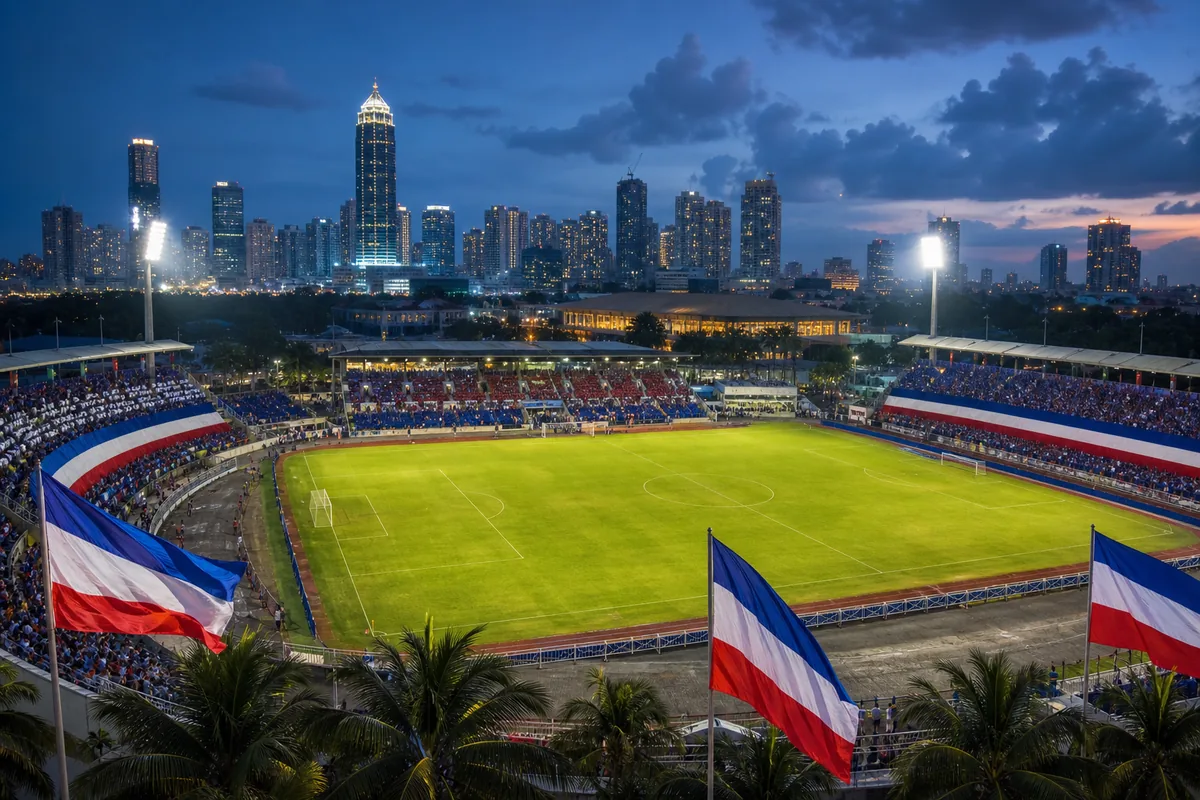
The 2019 Asian Cup debut supplied a continental benchmark
The Philippines qualified for the 2019 Asian Cup by topping their final-round group unbeaten. The decisive match against Tajikistan became a landmark: Kevin Ingreso equalised before Phil Younghusband's stoppage-time penalty secured a 2-1 victory and the country's first place at the finals.
The tournament in the United Arab Emirates exposed the next level. The Philippines lost 1-0 to Korea Republic, 3-0 to China and 3-1 to Kyrgyz Republic. Stephan Schröck scored the country's first Asian Cup finals goal in the final group match.
Three defeats and a minus-six goal difference meant elimination, yet the opening match showed that the team could remain organised against one of Asia's strongest sides. The difficulty was reproducing that concentration while also creating enough possession and chances to change a game.
A first appearance matters because it turns an abstract ambition into experience shared by players, staff and supporters. The failure to qualify for the 2023 edition showed that one debut did not automatically create permanence. Every subsequent cycle has therefore been judged against the same question: can the Philippines become an Asian Cup regular?
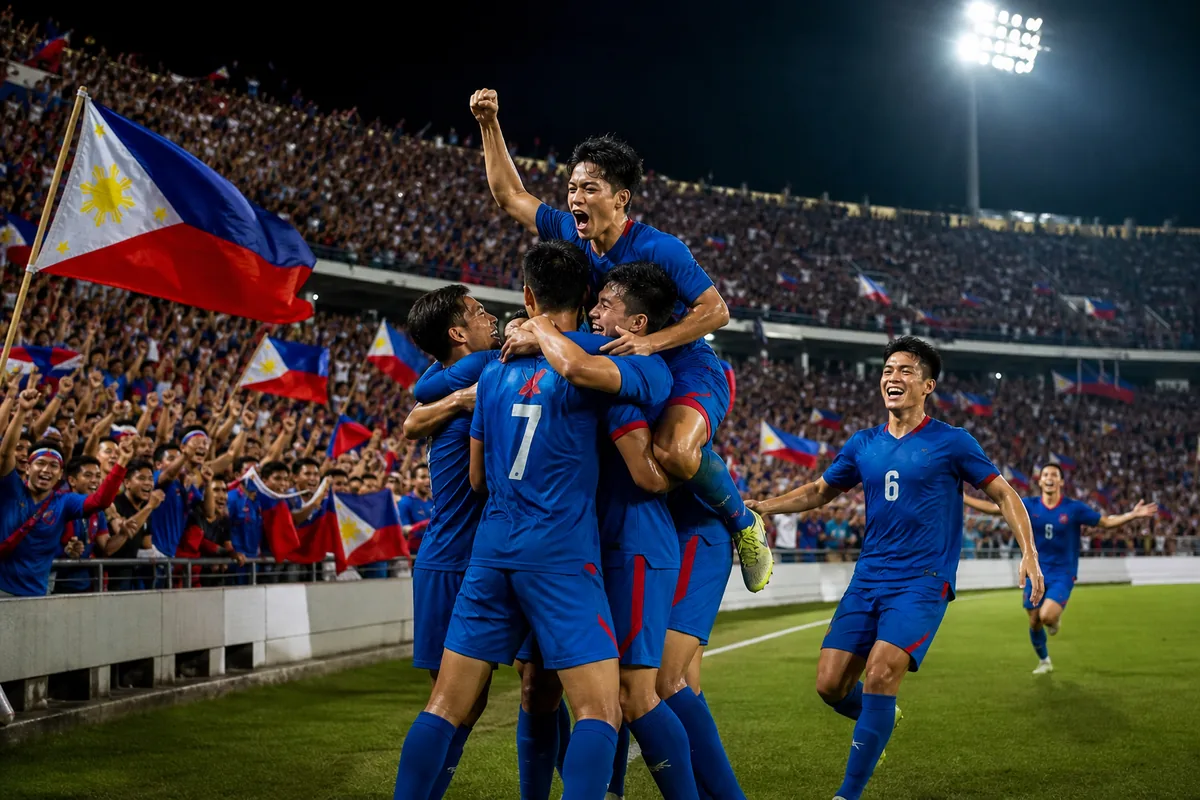
Four wins and two draws still did not secure the 2027 finals
The final qualifying round for Saudi Arabia 2027 placed the Philippines with Tajikistan, Maldives and Timor-Leste. Only the group winner would advance, leaving almost no space for a dropped point or a lost goal-difference battle.
The Philippines completed six matches unbeaten, collecting 14 points from four wins and two draws. The final fixture in Hisor became a direct contest for first place. The Philippines took the lead before Tajikistan equalised, but the 1-1 draw preserved the hosts' advantage on goal difference.
Both teams finished on 14 points. AFC confirmed Tajikistan as the qualifier and the Philippines as the narrow loser. It was a much stronger campaign than the simple word eliminated suggests: the team did not lose and still missed the tournament.
The lesson is numerical. In a one-place group, beating the lower-ranked opponents is not enough; the size of those victories and the direct matches with the principal rival both matter. Protecting a lead, continuing to attack after taking control and avoiding unnecessary concessions can determine qualification months later.
The Philippines' senior men's record at a glance
| Competition | Best or latest result | Correct context |
|---|---|---|
| AFC Asian Cup | Group stage, 2019 | Three defeats; first finals goal scored against Kyrgyz Republic |
| Asian Cup 2027 qualifying | Second in Group A | Unbeaten on 14 points, behind Tajikistan on goal difference |
| FIFA World Cup | Never qualified | Eliminated in AFC Round 2 in the 2026 cycle |
| ASEAN Championship | Semi-finals | Reached the last four in 2010, 2012, 2014, 2018 and 2024 |
| 2024 ASEAN semi-final | Lost 4-3 on aggregate | Beat Thailand 2-1 at home before an extra-time defeat away |
| Major titles tracked | None | A second Asian Cup appearance remains the continental target |
The record shows two related stories. Regionally, the Philippines have become a credible semi-final team. Continentally, they have one finals appearance and have now completed an unbeaten campaign that fell short only on a tiebreaker. The next advance is conversion, not reinvention.
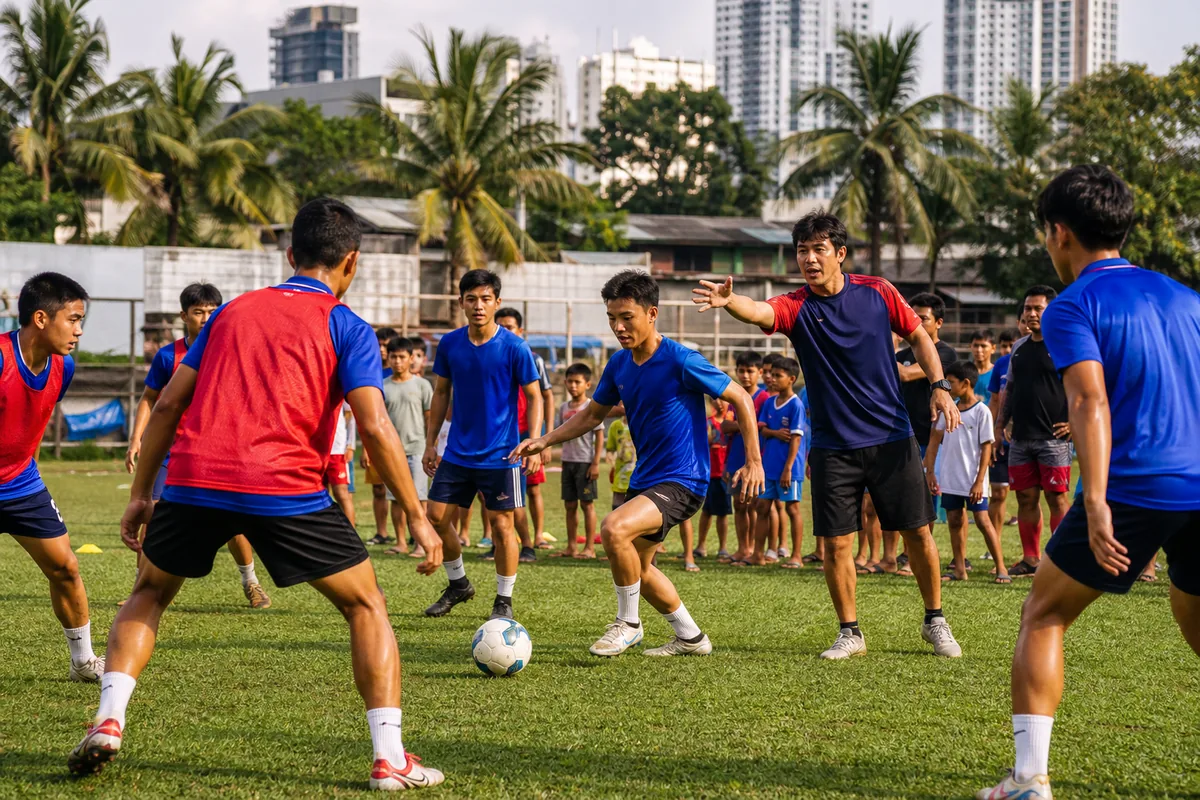
The next campaign must treat goal difference as a tactical objective
The Philippines' player pool benefits from footballers developed in different domestic systems, but short international windows make cohesion difficult. A clear framework is more valuable than changing shape for every opponent.
Against regional peers, the team need to create sustained pressure after scoring. Wide players can hold the touchline to stretch a compact block, while midfield runners attack the space created inside. The objective is not reckless pursuit of goals; it is avoiding the passive phases that leave a one-goal match vulnerable.
Against stronger opponents, the spacing changes. The midfield must remain close enough to the defensive line to deny passes between the units, and the first forward outlet needs support. The narrow defeat by Korea Republic in 2019 showed the value of collective distances, even when possession is limited.
Set pieces connect both plans. They can increase margins against lower-ranked opponents and provide the best chance in matches where open-play opportunities are scarce. Delivery quality, second-ball positioning and defensive organisation should be trained as one system.
The 14-point qualifying campaign gives the Philippines evidence that a return to the Asian Cup is realistic. The next cycle begins with a precise standard: remain difficult to beat, turn control into larger advantages and enter the final direct match without relying on another team's result or a tiebreaker.

The Philippines' route from a near-miss to a regular Asian Cup place


Frequently asked questions
Have the Philippines ever qualified for the AFC Asian Cup?
Yes. The Philippines made their Asian Cup debut in 2019.
How did the Philippines perform at the 2019 Asian Cup?
They lost all three group matches, scoring once and conceding seven goals.
Did the Philippines qualify for the 2027 Asian Cup?
No. They finished level with Tajikistan on 14 points but missed the only qualifying place on goal difference.
Were the Philippines unbeaten in 2027 Asian Cup qualifying?
Yes. Their six-match campaign produced four wins and two draws.
Have the Philippines ever qualified for the FIFA World Cup?
No. The Philippines have never appeared at the men's World Cup finals.
What is the Philippines' best ASEAN Championship result?
Their best finish is the semi-finals, reached in 2010, 2012, 2014, 2018 and 2024.
Data sources & verification for Philippines
Trophy dates are checked against official competition information and the relevant football confederation.
- AFC — the Philippines secured their first Asian Cup qualification
- AFC — official 2019 Asian Cup history book and group record
- AFC — Korea Republic's 1-0 win in the Philippines' finals debut
- AFC — Kyrgyz Republic's 3-1 win and the Philippines' first finals goal
- AFC — the 2026 World Cup qualifying defeat in Vietnam
- ASEAN United FC — the Philippines returned to the semi-finals in 2024
- ASEAN United FC — Thailand won the semi-final 4-3 on aggregate
- AFC — Tajikistan qualified ahead of the Philippines on goal difference
- AFC — final Asian Cup qualifying results and confirmed group winners
See the Philippines' Waiting Room profile, tournament record and live trophy counter.
View the Philippines' Waiting Room profile →