
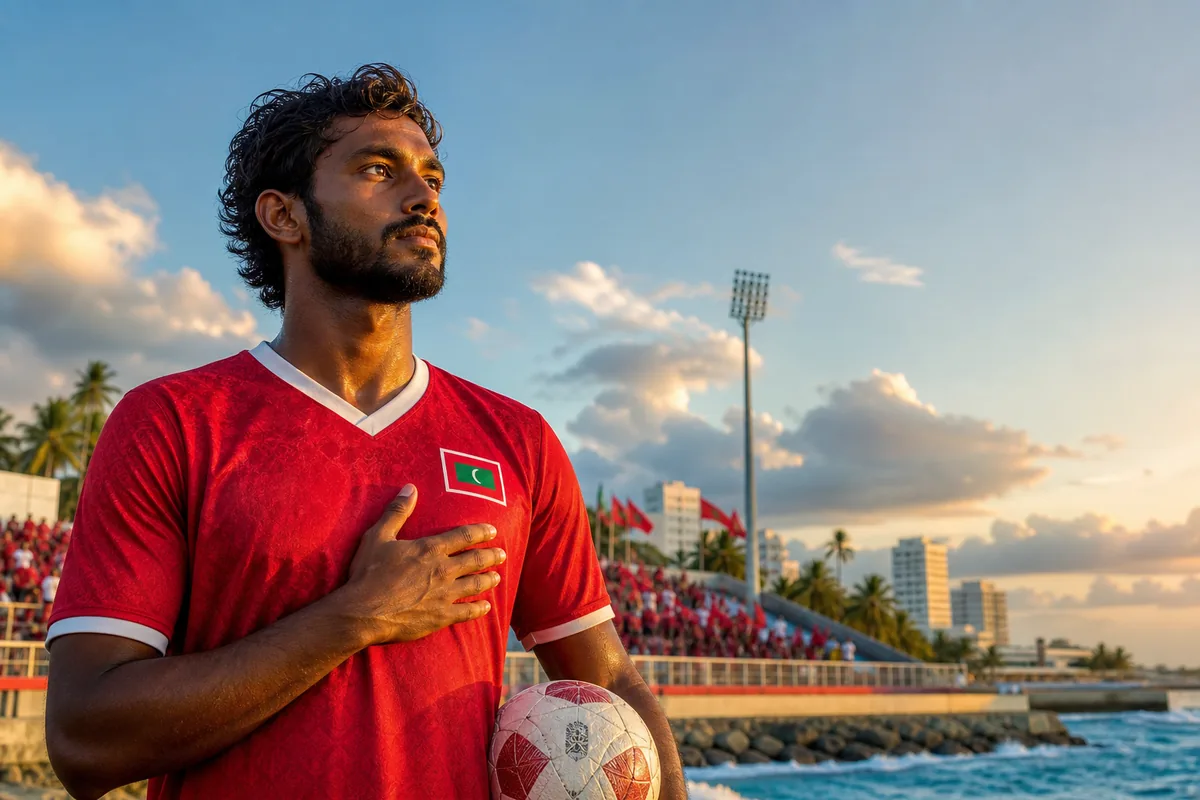
Maldives have already proved that a small island nation can build a winning football identity. The national team won the SAFF Championship in 2008 and again in 2018, beating India 2-1 in the second of those finals. Those are meaningful senior regional trophies, but they are not the AFC Asian Cup. Maldives have never crossed the line into either the Asian Cup or FIFA World Cup finals. The latest cycle made the gap unusually clear: Bangladesh ended the 2026 World Cup route 3-2 on aggregate, while Maldives collected their only points of the 2027 Asian Cup final qualifying round in the last match, a 2-1 win over Timor-Leste. The national story is therefore not one of having won nothing. It is about turning proven South Asian quality into sustained continental competitiveness.
World Cup 2026 status
Maldives drew the first leg 1-1 at home, then lost 2-1 in Dhaka on 17 October 2023. Bangladesh advanced 3-2 on aggregate, ending Maldives' 2026 World Cup campaign at the first hurdle. The island nation have still never appeared at a World Cup finals.
| 2026 status | Qualification route | Outcome |
|---|---|---|
| Eliminated in the first AFC qualifying round | AFC preliminary joint qualification | Lost 3-2 on aggregate to Bangladesh |

Maldives won their first SAFF Championship

Ali Ashfaq scored ten goals across the 2013 SAFF Championship, not against India in one match
Maldives beat India to win their second SAFF title

Bangladesh ended the 2026 World Cup qualifying route

Maldives beat Timor-Leste but missed the 2027 Asian Cup
The two SAFF titles are the foundation, not the finish line
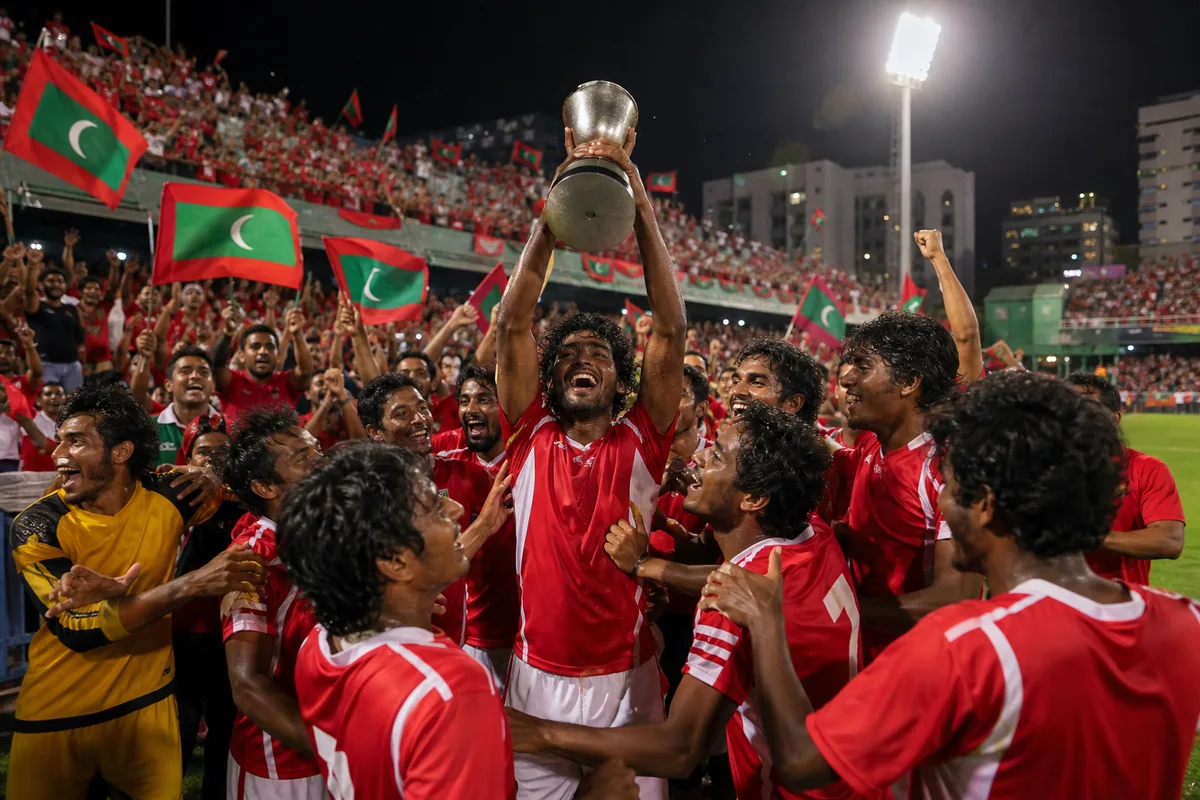
The 2008 SAFF Championship gave Maldives their first senior regional crown and a permanent reference point for what the national team could achieve. A decade later the island side did it again. India entered the 2018 final as favourites and had already beaten Maldives 2-0 in the group stage, but Ibrahim Mahudhee Hussain scored in the first half and Ali Fasir added a second after the interval. India pulled one back late; Maldives held on for a 2-1 victory.
That second title was especially revealing because Maldives had reached the knockout stage only after a coin toss separated them from Sri Lanka. Once given the opportunity, they beat Nepal in the semi-final and reversed the earlier loss to India. Tournament football often depends on surviving an imperfect group phase, then executing under pressure. Maldives demonstrated both qualities.
The distinction between regional and continental success matters. SAFF brings together South Asian teams and gives Maldives realistic knockout opportunities. The Asian Cup qualifying field is broader, deeper and less forgiving. Two SAFF titles prove that the country has a football ceiling above its size; they do not count as Asian Cup appearances or erase the continental drought.
Maldives' senior tournament markers
Ali Ashfaq gave Maldivian football a continental reference point
Ali Ashfaq is the individual figure most closely associated with the rise of Maldivian football. FIFA recorded him as the country's all-time leading international scorer with 53 goals in 80 matches as of 2020. Fourteen of those goals came in World Cup qualifying, and ten arrived during the 2013 SAFF Championship alone.
His 2013 scoring year reached far beyond South Asia. Counting international and major continental club matches, Ashfaq scored 23 times, a total FIFA noted placed him only two behind Cristiano Ronaldo in the relevant IFFHS ranking. For a player who began in neighbourhood football rather than an academy, that visibility changed how a Maldivian pathway could be imagined.
The harder question is succession. A national team cannot rely indefinitely on one exceptional scorer to turn low-possession matches into goals. Maldives need more forwards who can threaten space, more midfielders capable of playing through pressure and enough depth that the tactical plan survives substitutions. Ashfaq's legacy should be treated as a development standard: the system must produce several reliable attacking references, not wait for another isolated phenomenon.

The latest qualifying cycle exposed both resilience and fragility
The 2026 World Cup route ended against Bangladesh in October 2023. Maldives drew 1-1 in the home leg but lost 2-1 in Dhaka, with Foysal Fahim scoring the decisive goal. A 3-2 aggregate defeat is not a gulf; it is precisely the kind of narrow tie that turns on defensive concentration, restarts and the ability to score away from home.
Because of their ranking among the losing teams from that preliminary round, Maldives still entered the final qualifying stage for the 2027 Asian Cup. They were drawn with Tajikistan, the Philippines and Timor-Leste in Group A. Only the group winner qualified. Maldives went into the last match without a point, then came from behind to beat Timor-Leste 2-1 on 31 March 2026.
That victory prevented a pointless campaign, but it arrived too late to affect qualification. Tajikistan topped the group and reached the finals. The lesson is sharper than a generic call for improvement: Maldives must collect points before the final matchday. A six-game group rewards repeatability, and one isolated win cannot compensate for five defeats.
Maldives' senior men's record at a glance
| Competition | Best or latest result | Correct context |
|---|---|---|
| SAFF Championship | Champions, 2008 and 2018 | Two senior South Asian regional titles |
| AFC Asian Cup | Never qualified | Won one of six matches in the 2027 final qualifying round |
| FIFA World Cup | Never qualified | Lost 3-2 to Bangladesh in the first round of the 2026 cycle |
| 2018 SAFF final | Maldives 2-1 India | Second regional championship |
| 2027 Asian Cup qualifying | Maldives 2-1 Timor-Leste | First points arrived on the final matchday |
The table deliberately separates the SAFF Championship from the AFC Asian Cup. Maldives are regional champions twice over, but the country's first appearance at Asia's main national-team finals remains unclaimed.

The next breakthrough requires a team built for six-match campaigns
Maldives' immediate development target is not a speculative World Cup run. It is to enter the next Asian Cup route with enough depth to remain competitive from the first matchday to the sixth. The Bangladesh tie and the late Timor-Leste win show that individual matches are winnable. The missing quality is continuity across an entire cycle.
Geography adds a real constraint. A player pool spread across islands has fewer dense development centres and limited space for full-size training facilities. That makes coordination between schools, clubs and the national association especially important. Talent identification has to reach beyond Malé, while the best prospects need repeated high-level matches rather than occasional camps.
On the pitch, Maldives need to protect the centre without surrendering every transition. An outlet forward, a midfielder arriving underneath him and wide runners prepared to attack the second phase would help the team escape pressure. Set pieces also offer a route to goals that does not depend on dominating possession.
The two SAFF trophies already give Maldives something many developing teams lack: proof that a tournament can end with their captain lifting a cup. The next step is to translate that memory into continental standards—earlier points, fewer lost away legs and, eventually, a first Asian Cup finals appearance.

Maldives' route from South Asian champions to a first Asian Cup

Frequently asked questions
Has Maldives ever qualified for the AFC Asian Cup?
No. Maldives have never played in the men's AFC Asian Cup finals.
Has Maldives ever qualified for the FIFA World Cup?
No. Maldives have never reached the men's FIFA World Cup finals.
How many SAFF Championships have Maldives won?
Maldives have won the senior men's SAFF Championship twice, in 2008 and 2018.
Who did Maldives beat in the 2018 SAFF final?
Maldives beat India 2-1 in Dhaka. Ibrahim Mahudhee Hussain and Ali Fasir scored the two goals.
How did Maldives perform in 2026 World Cup qualifying?
Maldives drew 1-1 at home to Bangladesh and lost the second leg 2-1, going out 3-2 on aggregate in the first AFC round.
Did Maldives qualify for the 2027 Asian Cup?
No. Maldives finished their final qualifying group with a 2-1 win over Timor-Leste, but Tajikistan won Group A and took the finals place.
Data sources & verification for Maldives
Trophy dates are checked against official competition information and the relevant football confederation.
- AFC — Bangladesh eliminate Maldives 3-2 on aggregate in World Cup qualifying
- FIFA — Bangladesh advance after the 2-1 second-leg win
- AFC — Maldives beat India 2-1 to win the 2018 SAFF Championship
- AFC — official reference to Maldives as the 2008 SAFF champions
- FIFA — Ali Ashfaq's international scoring record and career
- AFC — Maldives 2-1 Timor-Leste and the final 2027 Asian Cup qualifying outcome
See Maldives' Waiting Room profile, tournament record and live trophy counter.
View Maldives' Waiting Room profile →Record sources
Playing dates, tournament editions and qualifying results are distinguished from finals appearances and titles.