
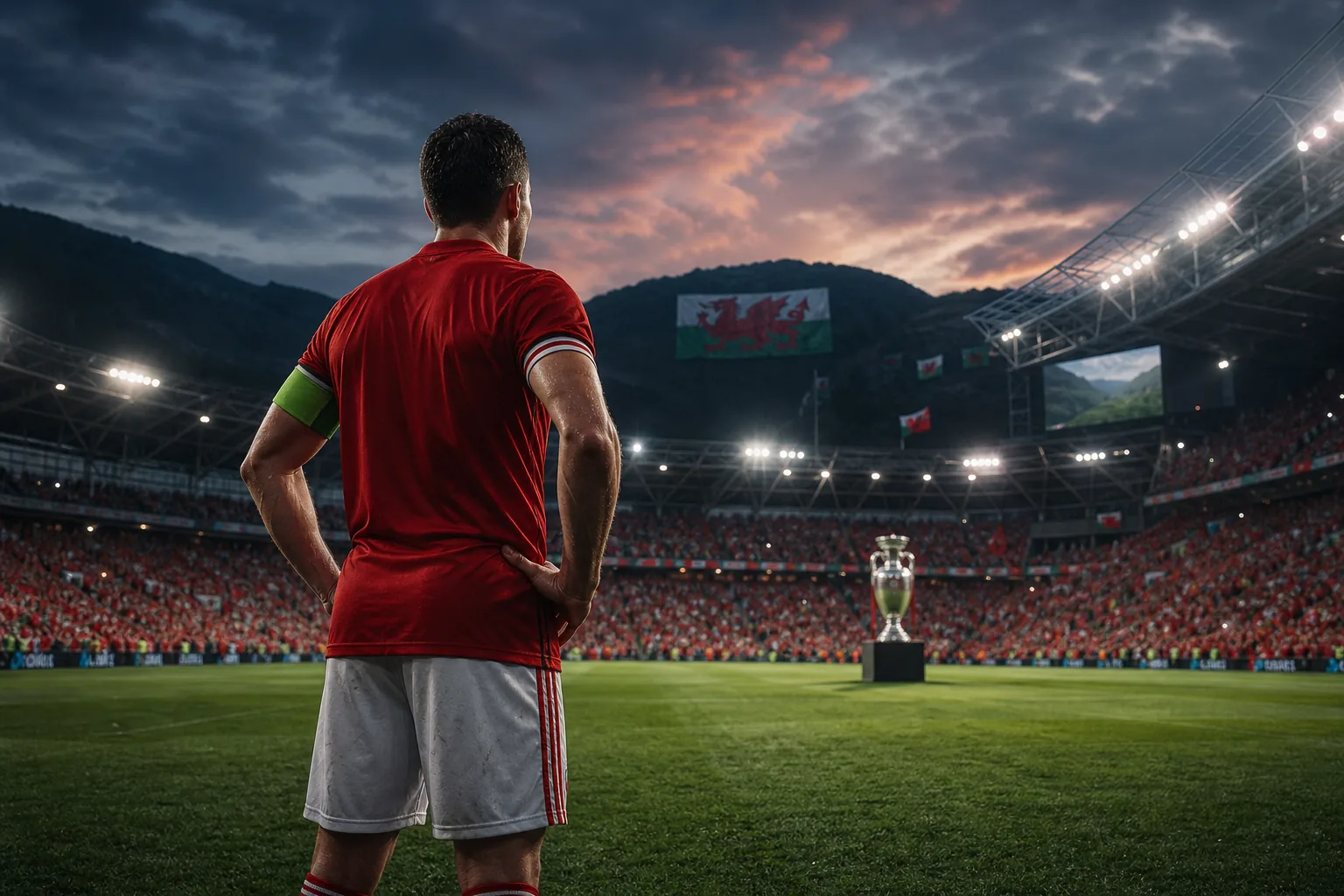
Wales have spent much of their history fighting simply to reach major tournaments, which makes their best runs unusually vivid. The 1958 team pushed Brazil in a World Cup quarter-final, while the 2016 side transformed a first EURO finals appearance into a semi-final. Neither generation reached the match where the trophy was decided.
World Cup 2026 status
Wales entered UEFA qualifying for the 2026 FIFA World Cup but did not reach the finals. Their two World Cup appearances remain 1958 and 2022.
| 2026 status | Qualification route | Outcome |
|---|---|---|
| Entered qualifying; did not qualify | UEFA qualifying | Did not reach the finals |

Wales reached the World Cup quarter-finals and lost 1–0 to Brazil

A 3–1 win over Belgium carried Wales into the EURO semi-finals

Wales reached the EURO 2020 round of 16

The 64-year wait for another World Cup appearance ended

Wales did not qualify for the 2026 World Cup
Still waiting for a first major final and title
The 1958 World Cup showed what Wales could be at full strength
Wales reached their first World Cup through a play-off against Israel and travelled to Sweden in 1958 with a side built around Juventus forward John Charles. Three draws in the initial group forced a play-off against Hungary. Wales came from behind to win 2–1 and reached the quarter-finals without losing a match.
Charles was injured and could not face Brazil. Even without their leading forward, Wales kept the eventual champions scoreless until the 66th minute, when 17-year-old Pelé scored the only goal. It was his first at a World Cup and Wales had taken Brazil closer than the scorelines in the semi-final or final would suggest.
That run established a standard but not a habit. Wales then remained away from the World Cup for 64 years — the longest gap between appearances by any national team. Generations featuring Ian Rush, Neville Southall, Mark Hughes, Ryan Giggs and Gary Speed all came close without qualifying.
Wales' major-tournament profile

EURO 2016 turned qualification into the greatest modern Welsh run
Wales qualified for a European Championship final tournament for the first time in 2016. Gareth Bale had carried much of the scoring burden during qualification, but the tournament in France demonstrated that the team was more than one star. A compact shape, aggressive wing-backs and unusual collective trust made Wales difficult to unsettle.
Two group-stage victories, including the opening win over Slovakia, took Wales to the top of their group despite a late defeat by England. Northern Ireland were beaten 1–0 in the round of 16. The quarter-final against Belgium then became the defining match: Ashley Williams, Hal Robson-Kanu and Sam Vokes scored as Wales recovered from an early deficit to win 3–1.
Portugal won the semi-final 2–0. Aaron Ramsey's suspension removed one of Wales' most important connectors, while Ben Davies was also unavailable. The loss prevented a first final, but six matches, four victories and ten goals made the campaign the clearest evidence that Wales could compete deep into a major tournament.
The golden generation returned twice more
At EURO 2020, played in 2021, Wales again escaped the group. A draw with Switzerland and victory over Türkiye were enough before Denmark ended the campaign 4–0 in the round of 16. The result showed the difference between surviving a group and reproducing the balance of 2016.
Wales finally ended the 64-year World Cup absence in 2022. Bale scored twice against Austria in the play-off semi-final, and his free kick created the decisive own goal against Ukraine in Cardiff. At the finals, Wales drew 1–1 with the United States but defeats by Iran and England produced a group-stage exit.
The 2026 qualifying campaign did not deliver another World Cup. That makes the central question more urgent: how can Wales preserve the standards of the Bale-Ramsey generation while building a new attacking identity around players entering their prime?

Wales' men's tournament record at a glance
| Competition | Best result | Final-tournament appearances |
|---|---|---|
| FIFA World Cup | Quarter-final, 1958 | 2 — 1958, 2022 |
| UEFA European Championship | Semi-final, 2016 | 2 — 2016, 2020 |
| Most recent World Cup | Group stage | 2022 |
| Major titles tracked | None | Still waiting |
Wales also reached the quarter-final stage of the 1976 European Championship competition, losing a two-leg tie to Yugoslavia. At that time only four teams advanced to the final tournament, so UEFA's modern records distinguish that achievement from Wales' final-tournament appearances in 2016 and 2020.
The scarcity of appearances gives each successful campaign greater weight. Wales have reached the knockout phase in three of their four World Cup and EURO final tournaments: the 1958 World Cup quarter-final, the EURO 2016 semi-final and the EURO 2020 round of 16. Qualification has been rare, but arriving has often led to meaningful progress.
The 2016 side also offered a tactical lesson. Bale's speed and set pieces mattered, yet the platform came from coordinated defending, runners arriving from midfield and players accepting specific roles. The next successful Wales team does not need to imitate that lineup, but it must reproduce the same clarity.

The post-Bale challenge is to build another route to goals
Wales' next landmark is returning to a major finals tournament and reaching the knockout phase without depending on the retired Bale to decide its biggest moments. The current generation has athletic defenders, energetic midfielders and forwards capable of attacking space, but it still needs a repeatable way to create against compact opponents.
For a smaller player pool, availability is especially important. The 2016 semi-final illustrated how one suspension could change the team's ability to move the ball through midfield. Developing two credible options in key positions would make Wales less vulnerable across a qualifying campaign and a compressed tournament schedule.
A first major final is ambitious, but the route is no longer imaginary. Wales have already won a quarter-final and have already stood one match from the trophy. The task is to make qualification frequent enough that another exceptional run becomes possible rather than waiting decades for the opportunity.

Wales' road from rare qualification to a first major final


Frequently asked questions
Has Wales ever won the FIFA World Cup?
No. Wales' best World Cup result is the 1958 quarter-final, where eventual champions Brazil won 1–0.
What is Wales' best European Championship result?
Wales reached the EURO 2016 semi-finals after beating Belgium 3–1 in the quarter-final.
How many times have Wales played at the World Cup?
Wales have appeared twice, in 1958 and 2022. The 64-year gap between those tournaments is the longest between World Cup appearances.
How many EURO final tournaments have Wales reached?
Wales have played at two EURO final tournaments: 2016, when they reached the semi-finals, and 2020, when they reached the round of 16.
Did Wales qualify for the 2026 World Cup?
No. Wales entered UEFA qualifying but did not reach the 2026 finals.
What is Wales' next major target?
The immediate target is another finals appearance and knockout run. The historic target is a first World Cup or EURO final and title.
Data sources & verification for Wales
Trophy dates are checked against official competition information and the relevant football confederation.
See Wales' full Waiting Room profile and follow the current team in Wales Now.
View Wales' Waiting Room profile →