
On 30 July 1966, England beat West Germany 4-2 at Wembley to become world champions for the first and, so far, only time. Sixty years is a long wait by any measure — but England's story since then isn't really a story of failure. It's a story of arriving at the final door, over and over, and finding it locked by the narrowest of margins: a missed penalty, a disallowed goal, a stoppage-time equalizer. Seven times since 1966, England have reached the semifinal or final of a major tournament. Seven times, they've walked away without the trophy. This is that story — all the way through to a World Cup bronze medal in 2026 that, for the first time in decades, made the wait feel less like a curse and more like a team building toward something.
World Cup 2026 status
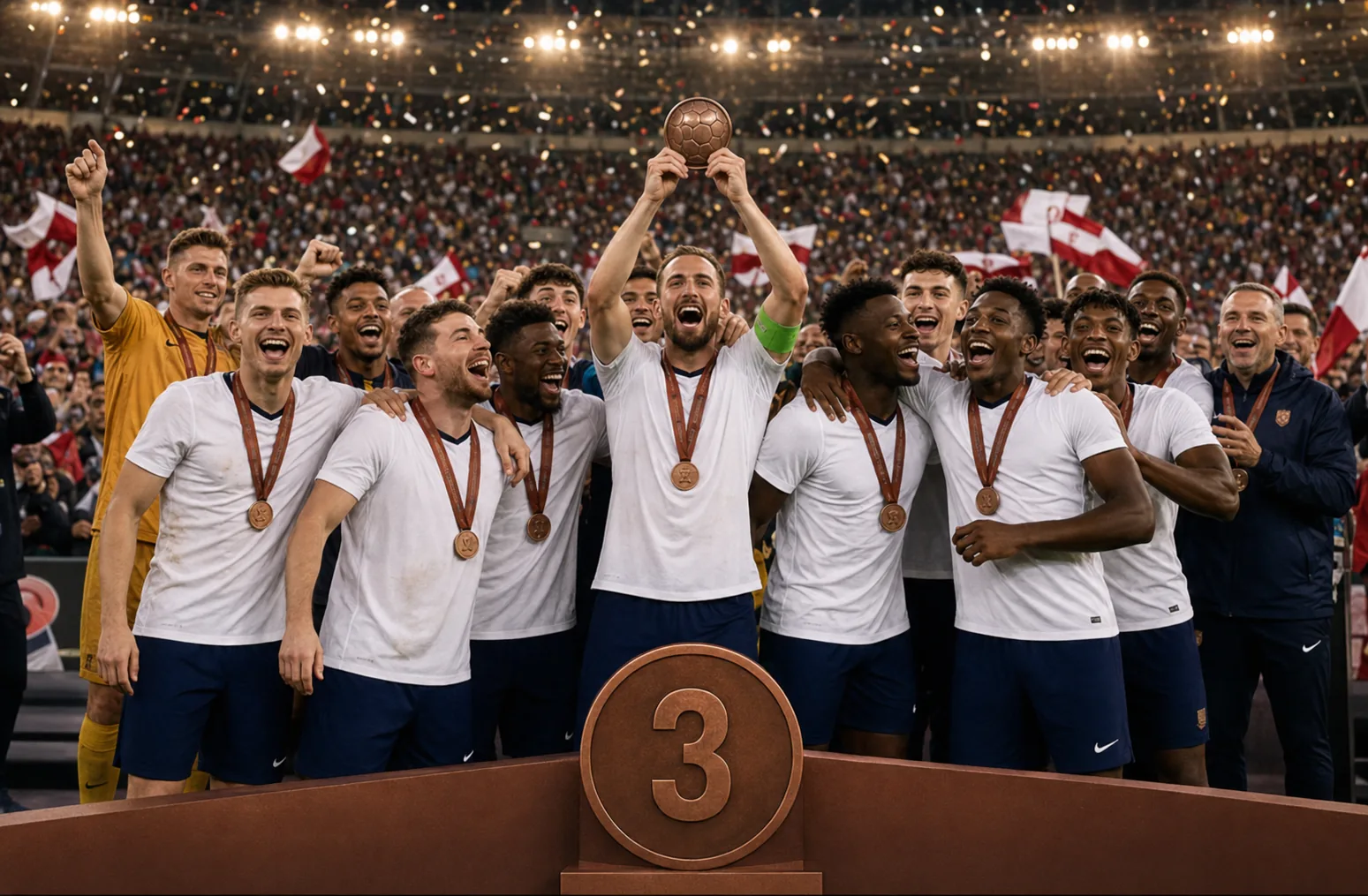
England qualified for and played at the 2026 FIFA World Cup, finishing third after beating France in the bronze-medal match.
| 2026 status | Qualification route | Outcome |
|---|---|---|
| Qualified and participated | UEFA qualifying | Third place |

World Cup, home
World Cup
World Cup — lost on penalties
Euro, home — lost on penalties

World Cup — lost on penalties

World Cup

Euro 2020, home — lost on penalties

Euro 2024

World Cup — bronze medal
1966: The Day Everything Changed
England didn't just win the World Cup in 1966 — they won it at Wembley, as hosts, in front of a home crowd that had waited its entire existence for this. Bobby Moore lifted the trophy. Geoff Hurst scored a hat-trick in the final that remains unmatched to this day. The fourth goal, with fans spilling onto the pitch and commentator Kenneth Wolstenholme's "they think it's all over... it is now" — became the single most replayed moment in English football history.
Nobody in that stadium could have imagined it would still be the only one, six decades later.
The Long Silence (1970–1990)
The most painful chapter didn't take long to arrive. At the 1970 World Cup in Mexico, England — defending champions, with essentially the same core squad — led West Germany 2-0 in the quarterfinal with twenty minutes left. West Germany scored twice, then again in extra time, and England were out. It was the first sign of a pattern that would define the next half-century: getting close, then losing control of a match England had seemingly won.
Worse followed. England failed to even qualify for the 1974 and 1978 World Cups, disappearing from the sport's biggest stage entirely during a decade when Brazil, West Germany, and Argentina were building football's modern history without them.
The wilderness years ended, in spirit if not in silverware, at Italia '90. Bobby Robson's England reached the semifinal, where a young Paul Gascoigne — booked, and therefore banned from the final had England progressed — was reduced to tears on the pitch, an image that became almost as iconic as 1966 itself. The match finished 1-1 after extra time. England lost the penalty shootout 4-3, their first-ever shootout defeat, to West Germany. It would not be their last.
Euro '96: Football's Coming Home
Six years later, England hosted a major tournament again, and the country turned it into a cultural moment. "Three Lions," the Baddiel, Skinner, and Lightning Seeds anthem built around the phrase "football's coming home," became the unofficial soundtrack of the summer. Paul Gascoigne's goal against Scotland — a flicked touch over Colin Hendry followed by a first-time volley, celebrated with the "dentist's chair" routine — is still shown before every England tournament as a reminder of what the team can be at its best.
England reached the semifinal again, and drew Germany again. Alan Shearer scored inside three minutes. Stefan Kuntz equalized. Neither side found a winner across 120 minutes, and the match went to penalties for the second time in England's history against the same opponent. This time it went to sudden death. Gareth Southgate — the future England manager, then a 25-year-old Aston Villa defender — stepped up for the sixth kick and was saved by Andreas Kopke. Andreas Moller scored Germany's next penalty, and the hosts were out of their own tournament.
The Golden Generation That Wasn't (2002–2006)
The early 2000s produced arguably the most talented English squads of the post-1966 era — David Beckham, Michael Owen, Steven Gerrard, Frank Lampard, Rio Ferdinand, and eventually a teenage Wayne Rooney, playing for some of the biggest clubs in Europe. The press dubbed them the "Golden Generation." The results didn't match the billing: three consecutive tournaments, three consecutive quarterfinal exits.
2002 brought a loss to Brazil, the eventual champions, 2-1, undone by a Ronaldinho free kick that may or may not have been intended as a shot. Euro 2004 and the 2006 World Cup both ended in penalty shootout defeats to Portugal — the 2006 exit compounded by Wayne Rooney's red card in the 61st minute, forcing England to play the rest of the match and all of extra time a man down. Only Owen Hargreaves converted his penalty that night; Lampard, Gerrard, and Jamie Carragher all missed.
Individually brilliant, collectively unable to get past the last eight — that became the defining tension of the decade.
Rock Bottom
If there was a low point in the sixty years, it stretched from 2010 to 2016. At the 2010 World Cup, England met Germany again in the round of 16 and had a clearly legitimate Frank Lampard goal disallowed — the ball crossed the line by nearly a yard, and goal-line technology didn't yet exist to prove it in real time. Germany won 4-1. Four years later, England didn't survive the group stage at all, losing to Italy and Uruguay and drawing Costa Rica.
Then came Euro 2016, and the single most humiliating result in the team's history: a 2-1 round-of-16 defeat to Iceland, a nation of roughly 330,000 people playing in their first-ever major tournament. It remains the benchmark against which every English football embarrassment since has been measured.
The Southgate Era Begins: World Cup 2018
Gareth Southgate — the man who missed the decisive penalty in 1996 — took over as England manager in 2016 and quietly rebuilt the team's relationship with the tournament that had haunted him as a player. At the 2018 World Cup in Russia, England faced Colombia in the round of 16 and, after a 1-1 draw through extra time, walked to the penalty spot again. This time, Jordan Pickford saved two Colombian penalties, and Eric Dier scored the winning kick. England had gone twenty-two years without winning a shootout at a major tournament. That single moment ended the streak.
England beat Sweden in the quarterfinal, then met Croatia in the semifinal — a first World Cup semifinal appearance since 1990. Croatia won 2-1 after extra time, going on to reach the final themselves. England lost the third-place playoff to Belgium. It wasn't the trophy, but it was the deepest World Cup run in 28 years, and the beginning of a team that no longer feared the big moments.
Euro 2020 Final: So Close at Wembley
Delayed a year by the pandemic, Euro 2020 still finished in the summer of 2021 — and England, playing every knockout match at Wembley, reached their first-ever European Championship final. Luke Shaw scored after just two minutes, the fastest goal in the history of a European Championship final. Italy responded through Leonardo Bonucci in the second half, and the match went to extra time, then penalties. Italy won the shootout 3-2. It was, by any measure, the closest England had come to a second trophy since 1966 — beaten on their own ground, on penalties, by a single kick.
Euro 2024 Final: Berlin Heartbreak
Three years later, England reached back-to-back European Championship finals — a feat no other men's team managed in the tournament's modern era. In Berlin, Spain took the lead through Nico Williams before Cole Palmer, on as a substitute, curled in an equalizer. Spain responded with a late winner from Mikel Oyarzabal, and England lost their second consecutive European Championship final, 2-1. The pattern that had defined six decades — arriving, and falling agonizingly short — showed no sign of breaking.
World Cup 2026: Bronze, Not Gold
Then came the expanded, 48-team World Cup across North America — and one of the most dramatic runs of England's modern history. They topped a group that included Croatia (beaten 4-2) and Panama (beaten 2-0), then survived a scare against DR Congo in the round of 32, trailing with fifteen minutes left before a late Harry Kane brace turned the match around. In the round of 16, England beat Mexico 3-2 at the Estadio Azteca while playing the majority of the match with ten men. The quarterfinal against Norway needed extra time to settle, 2-1.
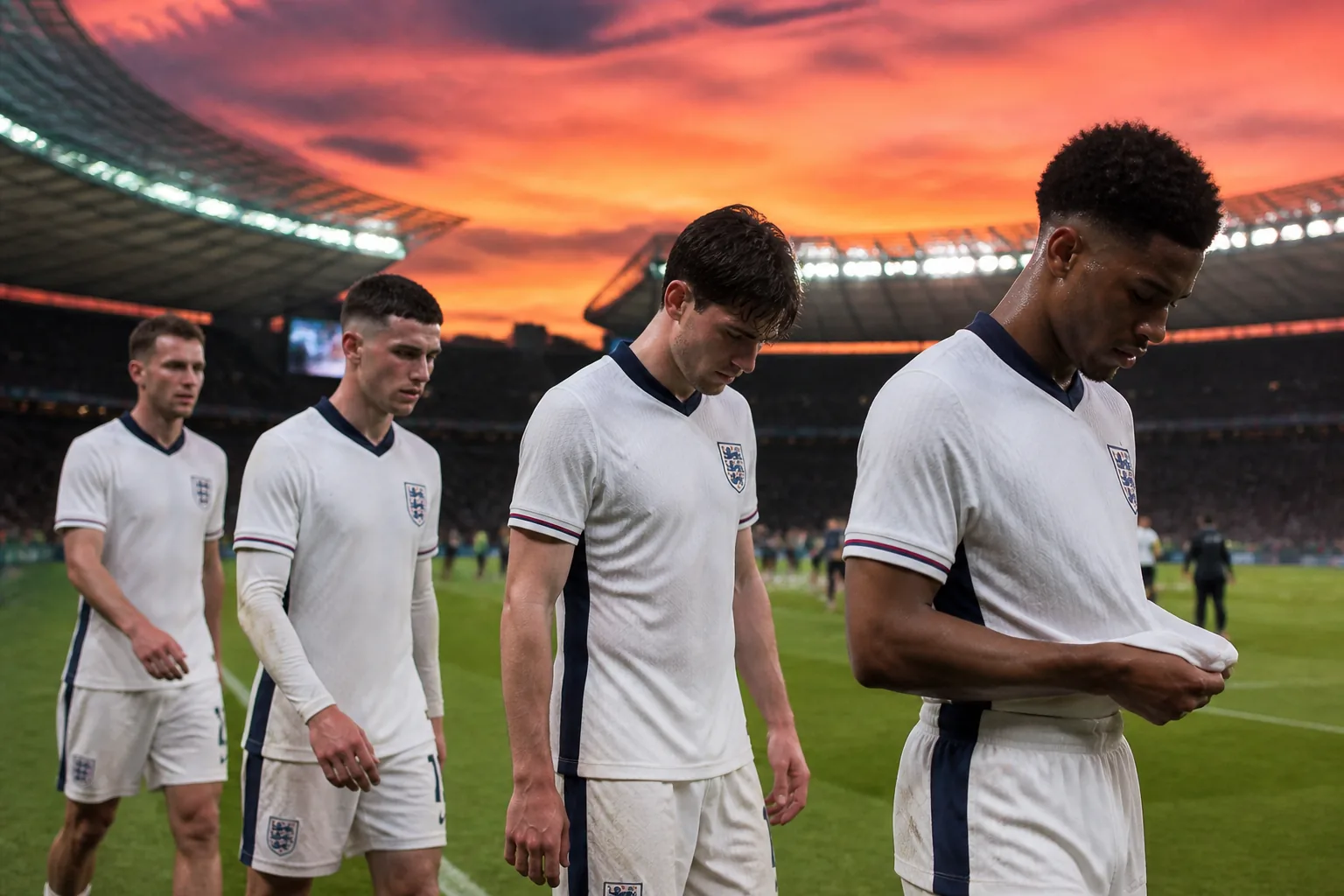
The semifinal brought Argentina, and England's run finally ended — a 2-1 defeat sealed by an Enzo Fernandez goal in the 85th minute and a Lautaro Martinez strike in stoppage time. But this England side didn't fade quietly in the third-place match: they beat France 6-4 in one of the most attacking, chaotic games of the entire tournament, with Bukayo Saka scoring a hat-trick. It was England's first World Cup medal of any color since 1966 — not the trophy, but the clearest sign yet that this generation belongs at the very top of the sport.
England's major tournament record at a glance
| Tournament | Best result | Key year(s) |
|---|---|---|
| FIFA World Cup | Winner | 1966 |
| UEFA European Championship | Runner-up | 2024 |
| Major titles | 1 | 1966 World Cup |
England's final-stage record
Looking Ahead: Euro 2028 at Home
The only time England has ever won a major trophy, they were playing at home. In 2028, for the first time since 1966, they'll get that chance again — co-hosting the European Championship alongside Wales, Scotland, Northern Ireland, and the Republic of Ireland. Sixty-two years will have passed since Bobby Moore lifted the World Cup at Wembley. Based on the last decade alone — two European Championship finals, a World Cup semifinal, and a World Cup bronze medal — England will arrive at their home tournament as one of the favorites for the first time in a generation. The wait has been long. It has also, finally, started to look like it's building toward something rather than just continuing.
Road to Bronze: World Cup 2026


Related teams and pages
Compare this story with other national teams and continue exploring TrophyDrought.


Frequently asked questions
When did England last win a major trophy?
England last won the 1966 FIFA World Cup, beating West Germany at Wembley.
How many major trophies has England won?
England have won one major senior men's trophy: the 1966 World Cup.
How many European Championship finals has England reached?
England reached the finals of Euro 2020 and Euro 2024.
Can England end the drought at Euro 2028?
Hosting Euro 2028 gives England another major opportunity, but the team must turn recent final appearances into a victory.
Data sources & verification for England
Last verified 2026-09-15. Trophy dates are checked against official competition information and the relevant football confederation.
See England's full trophy history, live counter, and every major final on one page.
View England's Trophy Drought →