 Japan Now · Samurai Blue
Japan.Find the next move.
Japan won the Kirin Cup after beating New Zealand 2–1. The November programme brings Brazil and Paraguay in Singapore. Japan v Brazil is scheduled for 14 November 2026 at 18:15 SGT in International friendly.
 Japan
Japan
Latest result: Japan 2–1 New Zealand
Full time · 5 October 2026Japan won the Kirin Cup after beating New Zealand 2–1. The November programme brings Brazil and Paraguay in Singapore.
Japan v Brazil is scheduled for 14 November 2026 at 18:15 SGT in International friendly. See the results and next schedule.
Result: match report or official results.
Where Japan stand now
Japan won the Kirin Cup after beating New Zealand 2–1. The November programme brings Brazil and Paraguay in Singapore. Japan v Brazil is scheduled for 14 November 2026 at 18:15 SGT in International friendly.
Hajime Moriyasu remains the head coach through the 2027 Asian Cup. Japan completed four home matches against Uruguay, Venezuela, Ecuador and New Zealand, finishing with the Kirin Cup title. The programme tested combinations, but its results do not predict the Asian Cup.
Japan 2–1 New Zealand
Japan won the Kirin Cup after beating New Zealand 2–1. The November programme brings Brazil and Paraguay in Singapore.
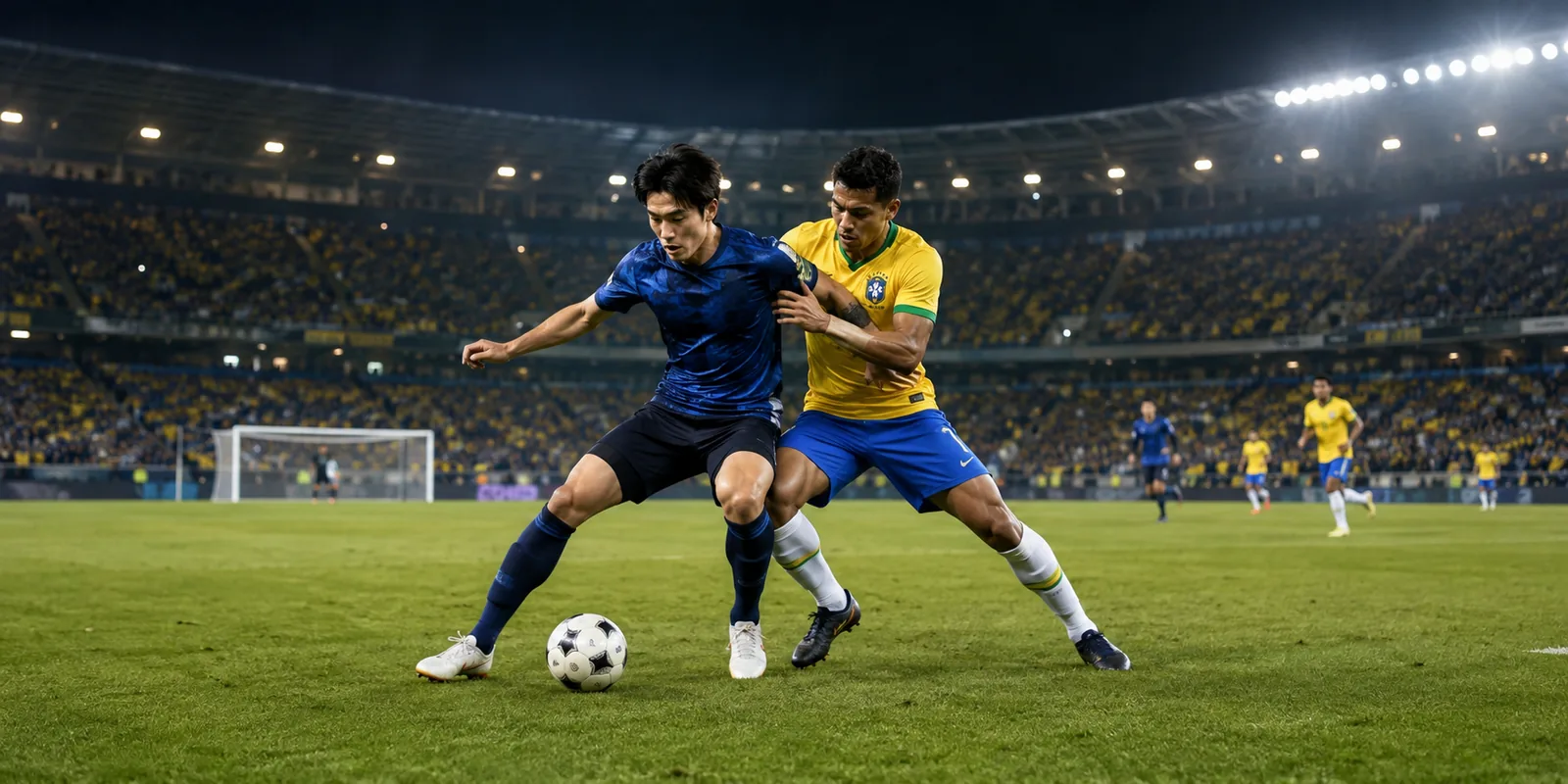
Japan v Brazil
Japan v Brazil is scheduled for 14 November 2026 at 18:15 SGT in International friendly.
The next squad is a separate announcement
The completed window establishes results and appearances. November selection, withdrawals and starting roles need fresh confirmation.
Confirmed context: JFA international match list, JFA World Cup results and the JFA coaching announcement. The interpretation is editorial analysis.
The World Cup: movement met a hard limit
Four matches · round-of-32 exitScores are from Japan's perspective. Dates are venue-local. The chart uses goals and excludes any shootout kicks.
| Form | Stage | Score | Opponent |
|---|---|---|---|
| D | Group F15 Jun | 2–2 | Netherlands |
| W | Group F21 Jun | 4–0 | Tunisia |
| D | Group F26 Jun | 1–1 | Sweden |
| L | Round of 3229 Jun | 1–2 | Brazil |
Goals scored and conceded
The Tunisia match showed how quickly Japan can turn a clean attacking sequence into a result.
Goals conceded across the tournament, including two in the Brazil elimination.
Clean sheet in four matches. The next step includes control after losing the ball.
The group stage gave Japan a wide range of problems: a high-scoring draw with the Netherlands, a convincing win over Tunisia and a controlled draw with Sweden. Brazil then exposed the difference between creating movement and making the decisive action arrive on time.
The useful review question is not whether Japan should attack less. It is whether the next receiver is already prepared when a defender closes the first route. Kubo, Doan, Kamada and the full-backs can all help answer that, but only if their distances remain connected.
Results and standings: JFA World Cup fixtures and results. Interpretation is editorial analysis.
Japan results and next matches
September–November 2026Japan won the Kirin Cup after beating New Zealand 2–1. The November programme brings Brazil and Paraguay in Singapore. Japan v Brazil is scheduled for 14 November 2026 at 18:15 SGT in International friendly.
Confirmed schedule: official competition or organiser listing.

Takefusa Kubo: the next receiver
Player focusGive the creative player a runway
Kubo changes the rhythm with a touch, a turn or a pass into the next line. Japan's challenge is to create the receiving angles before the defence has time to turn his space into a duel.
Kubo is not useful because he is expected to solve every attack alone. He is useful because his first touch can change the direction of an attack before a compact defence is ready. That makes the players around him part of the story.
Japan's next window should show whether the team can offer him several different pictures: a runner beyond the line, a midfielder close enough for a return pass and width that prevents the opponent from closing the whole side. Those relationships matter more than a single highlight.

For Japan's longer honours story, read Japan Asian Cup Wins: How Many AFC Titles?.
Movement is useful only when it connects
Editorial tactical model
Explore three attacking relationships
Choose a focus to change the passing routes. This simplified diagram is an editorial model, not tracking data, Moriyasu's confirmed system or a predicted starting XI.
Release Kubo into the half-space
The first pass draws a defender inside. Kubo can then receive in the half-space while a forward attacks the line.
Keep the width alive
A winger who stays wide can give the central receiver one more second before the defence collapses.
Make the return pass real
Japan's quick combinations work best when the first receiver has a safe option behind the pressure.
Attack the space beyond
One player coming short should be balanced by another threatening the last line.
Prepare for the turnover
Committing full-backs and midfielders forward requires a clear cover relationship behind the ball.
Six players, six things to watch
A watchlist, not a squad announcementThe roles below are editorial analysis based on the JFA's 2026 player information. They do not confirm current selection, fitness or starting status.
Takefusa Kubo
Can he receive facing forward, rather than first having to escape a closed space?
Ritsu Doan
Does his movement open the inside lane for another player, or does Japan crowd its strongest side?
Wataru Endo
How quickly can the team regain shape when an attack breaks down?
Ayase Ueda
Can his positioning give Kubo and the midfielders a destination beyond the first line?
Kaoru Mitoma
When he receives wide, does Japan create the support needed for a second action?
Takehiro Tomiyasu
Can the back line protect the spaces created when Japan's full-backs step forward?
Asian Cup 2027: the next ceiling
Saudi Arabia · January 7–February 5Japan's next major target is the AFC Asian Cup in Saudi Arabia. Japan have won Asia's premier men's tournament four times, most recently in 2011. The next edition is an opportunity to turn a strong World Cup qualification cycle into a deeper run when the pressure becomes continental rather than global.
The exact group-stage path should be checked against the latest AFC schedule. What can already be said is that the tournament gives Moriyasu's team a clear measure: can Japan produce more than a good first phase and make the knockout rounds a place where its combinations become sharper?
First objective: make the next phase harder to stop
The autumn friendlies are preparation, not silverware. The Asian Cup is where Japan's movement, depth and defensive recovery will be judged against the strongest teams in Asia.
Tournament dates: AFC Asian Cup information. Historical titles and the longer wait are covered on the Japan country page.
Japan now: frequently asked questions
Quick answersWhen is Japan's next match?
Japan v Brazil is scheduled for 14 November 2026 at 18:15 SGT in International friendly.
Who is Japan's head coach?
Hajime Moriyasu remains in charge of Samurai Blue through the 2027 Asian Cup, according to the JFA's July 2026 announcement.
How far did Japan get at the 2026 World Cup?
Japan reached the round of 32. They drew with the Netherlands, beat Tunisia, drew with Sweden and then lost 2–1 to Brazil.
What is Japan's next major target?
The AFC Asian Cup Saudi Arabia 2027 runs from January 7 to February 5, 2027. Japan will defend its place among Asia's leading teams.
Is this Japan's confirmed squad?
No. The watchlist and tactical model are editorial analysis, not a confirmed squad, injury bulletin or starting XI. Check the latest JFA announcement.
Why is the next window important?
The completed home window ended with a Kirin Cup title. Japan next face Brazil and Paraguay in Singapore in November before the 2027 Asian Cup.
Sources and update policy
Results, coaching status and fixtures are checked against JFA and AFC information. The player-role discussion and tactical model are editorial interpretation. This page is manually updated, not a live news feed.
New squads, injuries, venues and results need verification before publication. The chart calculates from the results table; the countdown points to a scheduled kick-off. Illustrations are conceptual scenes, not documentary photographs.
- JFA · international match list and autumn fixtures
- JFA · September–October 2026 squad and schedule
- JFA · World Cup 2026 fixtures, results and standings
- JFA · Japan national team players and staff
- JFA · Moriyasu continuation announcement · July 23, 2026
- AFC · Asian Cup 2027
- JFA · Kirin Cup semi-final report
Latest result and next calendar: verified report · confirmed next schedule.