
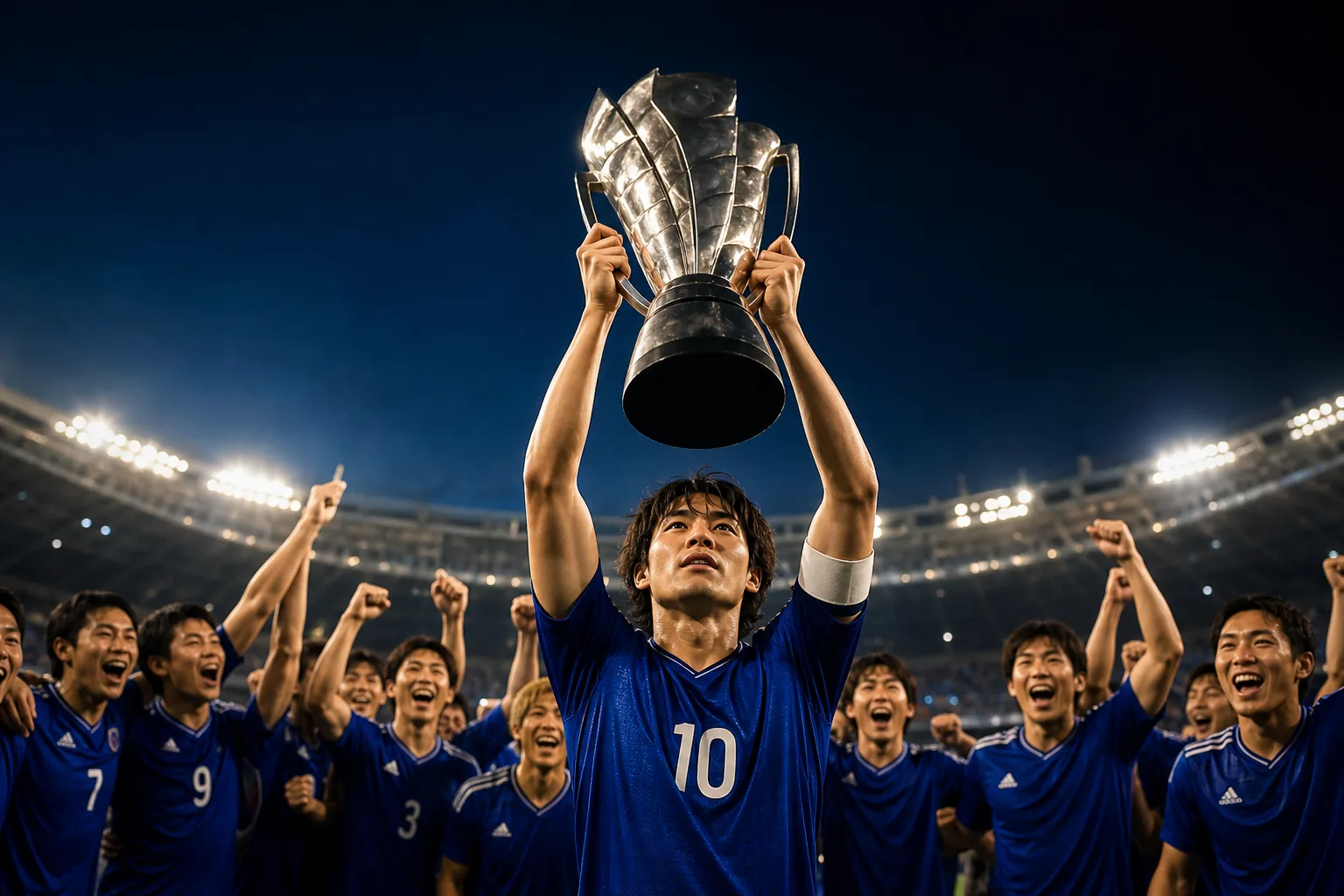
Japan are Asia's most successful Asian Cup team, with four continental titles. They have also become one of the continent's most reliable World Cup qualifiers, producing famous wins over Germany and Spain and reaching the round of 16 several times. Yet the next Asian Cup has continued to escape them. Japan's trophy drought is not about falling away; it is about a dominant football nation trying to turn consistency into another golden generation.
World Cup 2026 status
Japan qualified for and played at the 2026 FIFA World Cup, continuing the country's record of regular appearances on the global stage.
| 2026 status | Qualification route | Outcome |
|---|---|---|
| Qualified and participated | AFC qualifying | Round of 32 |

Japan won their first AFC Asian Cup title on home soil
Beat Saudi Arabia 1-0 to win a second Asian Cup

Beat China 3-1 to defend the continental title

Tadanari Lee's extra-time volley beat Australia

Lost the Asian Cup final 3-1 to Qatar

Still waiting for a fifth Asian Cup title
The strongest Asian Cup record still has a long pause
Japan have won the AFC Asian Cup four times — more than any other nation. That record makes the wait since 2011 feel unusually long. The Samurai Blue have remained competitive, qualified regularly for the World Cup and reached the 2019 Asian Cup final, but the fifth title has not arrived.
The drought is therefore a story of high expectations. For many Asian teams, reaching the knockout rounds is a breakthrough. For Japan, it is now the baseline. The question is whether the country's excellent football system can produce one more tournament team capable of surviving every late-stage test.

1992: Japan's first continental title
Japan won their first AFC Asian Cup in 1992. As hosts, they beat Saudi Arabia 1-0 in the final in Hiroshima; Takuya Takagi scored the winner. The JFA's Asian Cup history records the match.
The breakthrough came just before the J.League launched in 1993. Professional domestic competition and a clearer player pathway helped turn one home-tournament triumph into a sustained period of continental success.
2000 and 2004: dominance becomes a pattern
Japan won the Asian Cup again in 2000, beating Saudi Arabia 1-0, and defended the title in 2004 by defeating hosts China 3-1. The back-to-back victories confirmed that Japan had become the continent's most complete tournament program.
Hiroshi Nanami was the tournament MVP in 2000 and Shunsuke Nakamura received that award in 2004. Those are the players who defined these particular Asian Cup campaigns; Hidetoshi Nakata was not in either winning tournament squad. The team no longer needed a perfect home draw to win; it could travel, manage pressure and control matches against hostile crowds.
2011: the last title carries extra meaning
Japan's fourth Asian Cup title came in 2011, when Tadanari Lee scored a spectacular volley in extra time to beat Australia 1-0. The final was tight, physical and decided by one moment of technical quality — a fitting summary of Japan's tournament identity.
The victory made Japan the first nation to win four Asian Cup titles. Lee's 109th-minute volley also gave a young, Europe-based generation a defining tournament moment and reinforced Japan's reputation for technical control under knockout pressure.
Japan's tournament ceiling
2019: the fifth title slips away
Japan reached the 2019 Asian Cup final, but Qatar won 3-1. The defeat was not a collapse; it was a reminder that continental dominance is never permanent. Japan had reached another final, but the opponent was more efficient in the decisive moments.
The next edition, Asian Cup 2023 played in 2024, also ended without a fifth title: Japan lost 2-1 to Iran in the quarter-final on 3 February 2024. The 2019 final and that later exit extended the wait. Japan remained one of Asia's best sides, yet the gap between being a consistent finalist and being the champion again began to feel significant.

World Cup progress without a quarter-final
Japan's World Cup story has moved forward in visible steps. The Samurai Blue have reached the round of 16 several times, and the 2022 tournament produced one of the most impressive group-stage performances in their history: wins over Germany and Spain.
Japan's 2026 campaign ended one round earlier than their best: Brazil won 2-1 in the round of 32. The extra knockout round in the expanded tournament matters when comparing eras. A quarter-final still remains out of reach. Japan have repeatedly reached the moment when a strong tournament can become historic, then fallen short in the knockout round. The Asian Cup drought and the World Cup ceiling are connected: both demand the ability to perform one more perfect match under maximum pressure.

Japan's major tournament record at a glance
| Tournament | Best result | Key year(s) |
|---|---|---|
| AFC Asian Cup | Winner | 2011 |
| FIFA World Cup | Round of 16 | 2022 |
| Asian Cup titles | 4 | 1992, 2000, 2004, 2011 |
| Current major-trophy wait | Since 2011 | Ongoing |
What would end Japan's trophy drought?
Winning a fifth Asian Cup would be the clearest answer. Japan do not need to prove that their football system works; they need to finish another tournament with the trophy after the final whistle.
The World Cup target is equally clear: reach a quarter-final. Japan have already beaten global champions in the group stage, but the next breakthrough requires winning after the groups, when every opponent has the same preparation and there is no room for a single bad half.
Japan's drought is compelling because the ingredients are already there. The next title will not create the program; it will confirm that the program can keep producing champions.

The road from Asian dominance to a global breakthrough

Frequently asked questions
How many Asian Cup titles has Japan won?
Japan have won four AFC Asian Cup titles, the most in the tournament's history: 1992, 2000, 2004 and 2011.
When did Japan last win the Asian Cup?
Japan last won the Asian Cup in 2011, beating Australia 1-0 after extra time.
What is Japan's best World Cup result?
Japan have reached the round of 16 several times. Their best result remains the round of 16, including in 2022.
Why was Japan's 2011 title especially meaningful?
It made Japan the first four-time Asian Cup champion, with Tadanari Lee's 109th-minute volley deciding a tense final against Australia.
Can Japan win a fifth Asian Cup?
Yes. Japan remain one of Asia's strongest and most consistent programs, but they must turn regular World Cup progress and deep Asian Cup runs into another final victory.
Data sources & verification for Japan
Trophy dates are checked against official competition information and the relevant football confederation.
See Japan's full trophy history, live counter, World Cup record and major-tournament profile.
View Japan's country profile →