 Germany Now · The next chapter
Germany.A new spark.
Germany completed the opening Nations League window with 1 win, 2 draws and 1 defeat: 5 points, 3 goals scored and 2 conceded from four games. Serbia v Germany is scheduled for 13 November 2026 at 20:45 CET in UEFA Nations League · A2.
 Serbia
Latest result: Greece 0–0 Germany
Full time · 4 October 2026Germany completed the opening Nations League window with 1 win, 2 draws and 1 defeat: 5 points, 3 goals scored and 2 conceded from four games.
Serbia v Germany is scheduled for 13 November 2026 at 20:45 CET in UEFA Nations League · A2. See the results and next schedule.
Result: match report or official results.
Where Germany stand now
Germany completed the opening Nations League window with 1 win, 2 draws and 1 defeat: 5 points, 3 goals scored and 2 conceded from four games. Serbia v Germany is scheduled for 13 November 2026 at 20:45 CET in UEFA Nations League · A2.
The immediate challenge is not to invent talent. It is to connect the talent already available: give the creative players useful space, keep support near the ball and make the team harder to disrupt when a match stops going to plan. The opening four tests are complete. Germany finish the group against Serbia and a Netherlands team also beginning a new coaching cycle in November.
Greece 0–0 Germany
Germany completed the opening Nations League window with 1 win, 2 draws and 1 defeat: 5 points, 3 goals scored and 2 conceded from four games.
Serbia v Germany
Serbia v Germany is scheduled for 13 November 2026 at 20:45 CET in UEFA Nations League · A2.
The next squad is a separate announcement
The completed window establishes results and appearances. November selection, withdrawals and starting roles need fresh confirmation.
Confirmed context: DFB coaching announcement, World Cup group record, Paraguay match report and official fixtures. The interpretation is editorial analysis, not a statement of Klopp's instructions.
The World Cup: beyond the opening 7–1
Four matches · round-of-32 exitAll scores are from Germany's perspective. Dates are local to the match venue. Match statistics include extra time where played but exclude shootout kicks; the Paraguay tie was lost on penalties.
| Form | Stage | Score | Opponent |
|---|---|---|---|
| W | Group E14 Jun | 7–1 | Curaçao |
| W | Group E20 Jun | 2–1 | Côte d'Ivoire |
| L | Group E25 Jun | 1–2 | Ecuador |
| D | Round of 3229 Jun | 1–1After extra time Lost pens 3–4 | Paraguay |
Goals scored and conceded
Two wins, one draw and one loss; 11 goals for and five against. Shootout kicks excluded.
The first match, against Curaçao. A convincing start, but only one quarter of Germany's tournament.
The combined score across the next three games. One win, one loss and one draw before the shootout.
Clean sheets in four games. The attacking headline should not hide the other half of the scoreline.
Where the eleven goals came from
Opening match: 7 of 11 goals, or 63.6%. Remaining three matches: 4 of 11. This is a distribution of goals, not a measure of chance quality or opponent strength. Calculated from the results above.
The group ended with Germany on top, but the final group game provided a warning. Ecuador came from behind to win 2–1. Against Paraguay, Germany then had to chase the match themselves. Havertz's equaliser kept the tournament alive, but the next decisive goal never arrived.
The DFB's knockout report describes the difficulty of finding a route through a compact opponent. That matters for the next cycle because a strong team needs more than one speed: the speed to exploit open grass and the patience to build a chance when the grass disappears. One cannot simply be substituted for the other.
The opener should not be deleted from the story. Those seven goals happened. But removing it temporarily with the “After opener” filter is a useful way to see how the remaining results change the picture. It is a comparison, not an attempt to turn four matches into a complete model of Germany's quality.
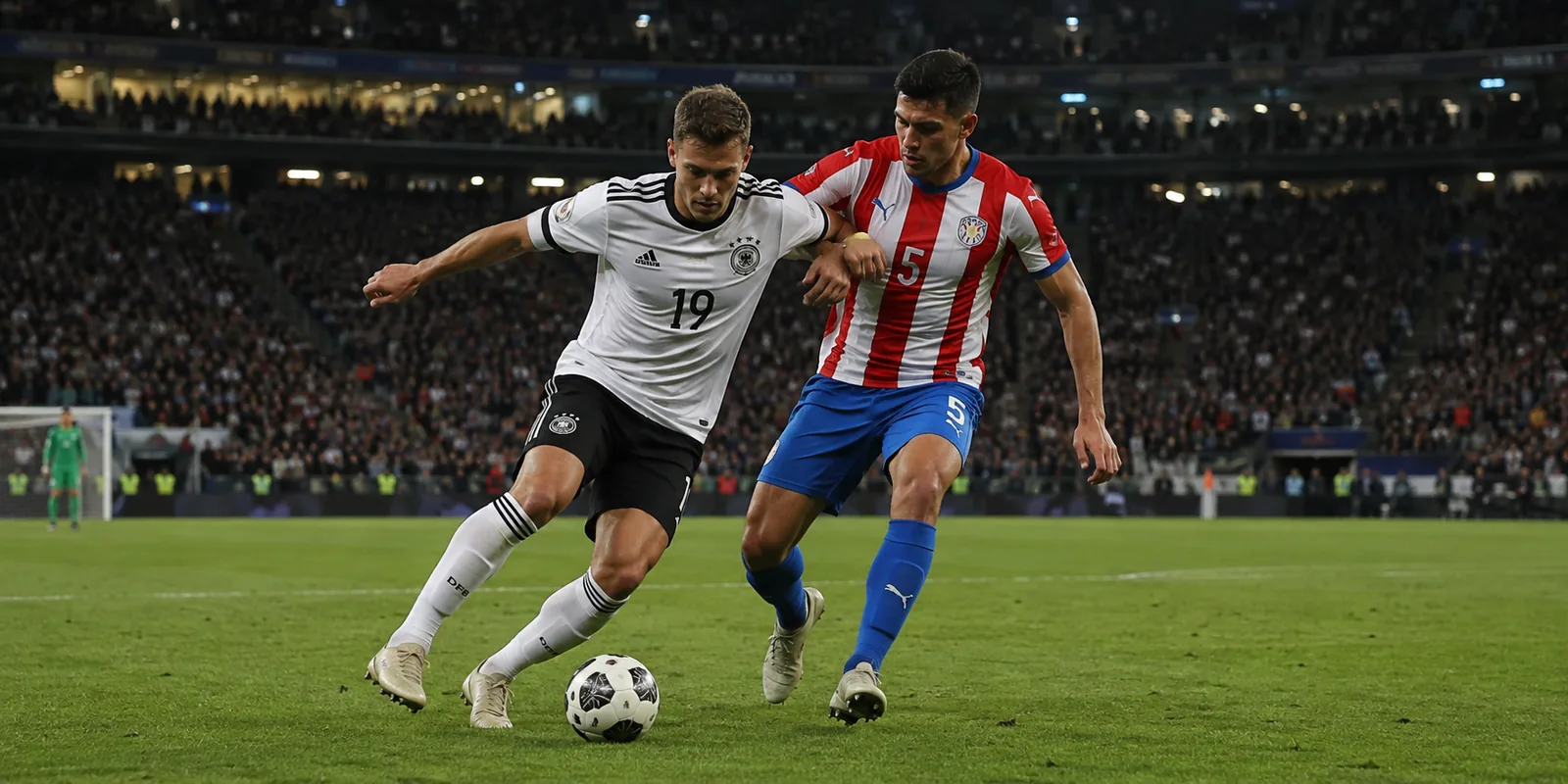
Group scores: DFB Datencenter. Round of 32: DFB report and FIFA's 1–1, 3–4 shootout record. Some German listings combine the match goals and converted penalties as 4–5; this page keeps them separate.
Germany autumn results and remaining fixtures
Nations League · Group A2Germany completed the opening Nations League window with 1 win, 2 draws and 1 defeat: 5 points, 3 goals scored and 2 conceded from four games. Serbia v Germany is scheduled for 13 November 2026 at 20:45 CET in UEFA Nations League · A2.
Confirmed schedule: official competition or organiser listing.
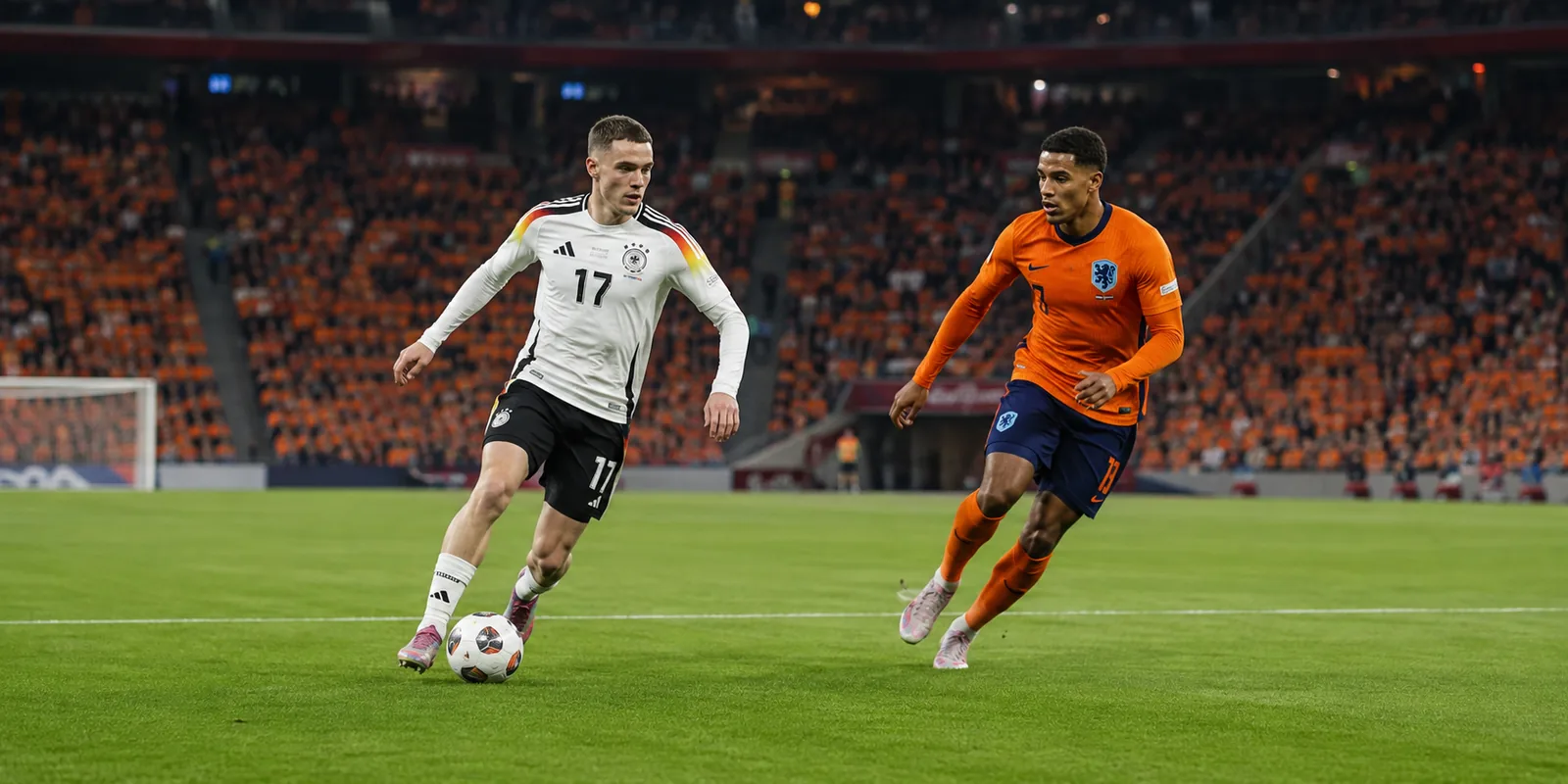
Explore the other side of the opener on Netherlands Now, then meet the remaining opponents through our Greece and Serbia pages.
Florian Wirtz: the value between the lines
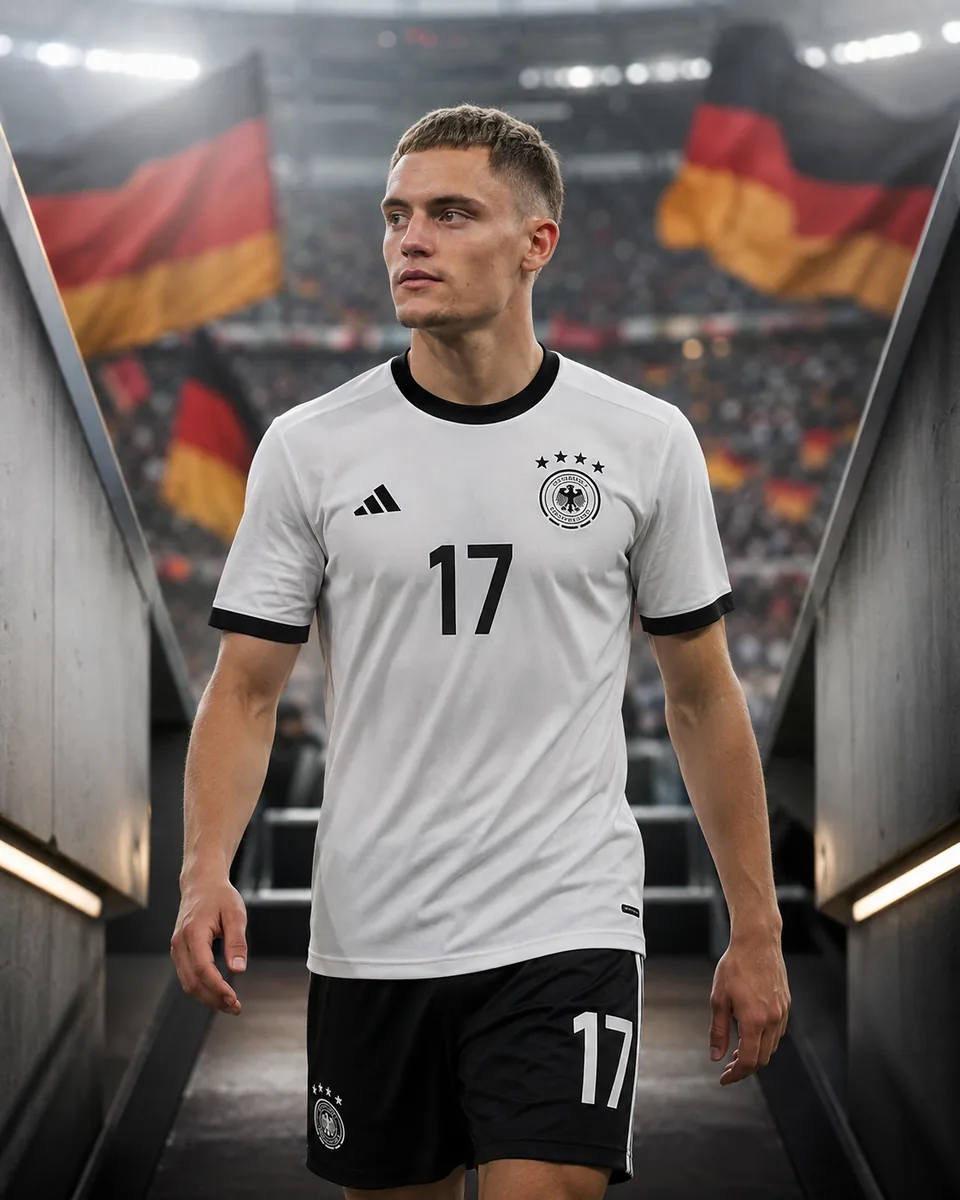
Player focusThe creative player needs a connected team
Wirtz can change a move with a short pass, a turn or a delivery into the box. Germany's task is to create situations in which those choices are available more often.
Wirtz arrived at his first World Cup as a 23-year-old creative reference, a role explored in FIFA's pre-tournament interview. The summer also showed why his contribution cannot be reduced to a goal tally. His short pass helped Sané score against Ecuador; his delivery found Havertz for the equaliser against Paraguay.
Those two actions were different solutions to different spaces. One was a quick connection near goal; the other a ball delivered from wider territory. Neither proves that Germany had solved their attacking problems. They do show why the team should give Wirtz options rather than expecting the same decisive action every time.
If Musiala attracts an opponent with a carry, Wirtz can become the next receiver. If a striker occupies the last line, he can receive with more room to turn. If every teammate moves toward the ball, however, the space closes. The interesting question is how the surrounding movement changes his choices.
The two examples are documented in FIFA's Ecuador report and the DFB's Paraguay report. They are not presented as a complete assist total. The positional discussion is editorial interpretation, not a confirmed role in Klopp's team.
For the longer story behind the present expectations, read Germany Trophy Drought: From World Cup Winners to a New Wait.
Talent is the start. Connections are the test.
Editorial analysis
Explore three attacking relationships
Choose a focus to change the passing routes. This simplified attacking-phase diagram is an editorial model, not tracking data, Klopp's confirmed system or a predicted starting XI. Only the relationships under discussion are shown.
Find Wirtz between the lines
The first midfielder draws pressure; the next pass finds Wirtz beyond it. A forward occupying the centre-backs and width on the far side can make his first touch face the goal. This is an attacking relationship to watch, not a confirmed formation.
Do not crowd the creators
Wirtz and Musiala do not need to occupy the same pocket to combine. One can draw an opponent while the other waits beyond the pressure. The useful question is who moves next, not who gets the nominal number-ten position.
Give the final pass a destination
A player receiving between the lines needs a run that stretches the last line. Without that threat, the defence can step forward and turn an apparently dangerous receiving position into a closed space.
Make the second action collective
The first runner can force a hurried pass, but that only helps if a teammate is ready for the next receiver. Watch the distances behind the press: enthusiasm without support can open the route Germany wanted to close.
Attack without abandoning the centre
The summer produced goals but no clean sheets. That does not identify one guilty position. It does make the balance behind the ball a useful autumn test: can Germany create pressure without conceding an easy counter?
Six players, six things to watch
September selection · roles analysedThe DFB announced Klopp's first selection on September 17: 44 players split across two groups for four matches, with a 24-player squad beginning against the Netherlands and Greece. The roles below are a broader editorial watchlist, not confirmation of September selection or November availability. They do not predict the starting XI. Read the official DFB announcement.
Florian Wirtz
How often can he receive facing the goal? A clever final pass depends on the earlier pass arriving before the defence has surrounded its next target.
Jamal Musiala
Does beating the first opponent open a route for someone else? His combinations with Wirtz are worth watching when one carries and the other moves out of the defender's sight.
Kai Havertz
When should the forward come short, and when should he stay on the last line? His positioning can help the creators receive or give their next pass somewhere to go.
Joshua Kimmich
Where does Germany need its organising voice? Whether the role starts wide or centrally, the important detail is how he connects the first pass to the next attacking line.
Aleksandar Pavlovic
Can the supporting midfielder offer a safe return without slowing every attack? The position must help possession and leave Germany ready if the next pass is intercepted.
Antonio Rüdiger
When is stepping into a duel supported by the players around him? An aggressive challenge is safer when a teammate is already covering the space it leaves.
The Klopp era: energy needs a repeatable plan
From a new voice to a new routine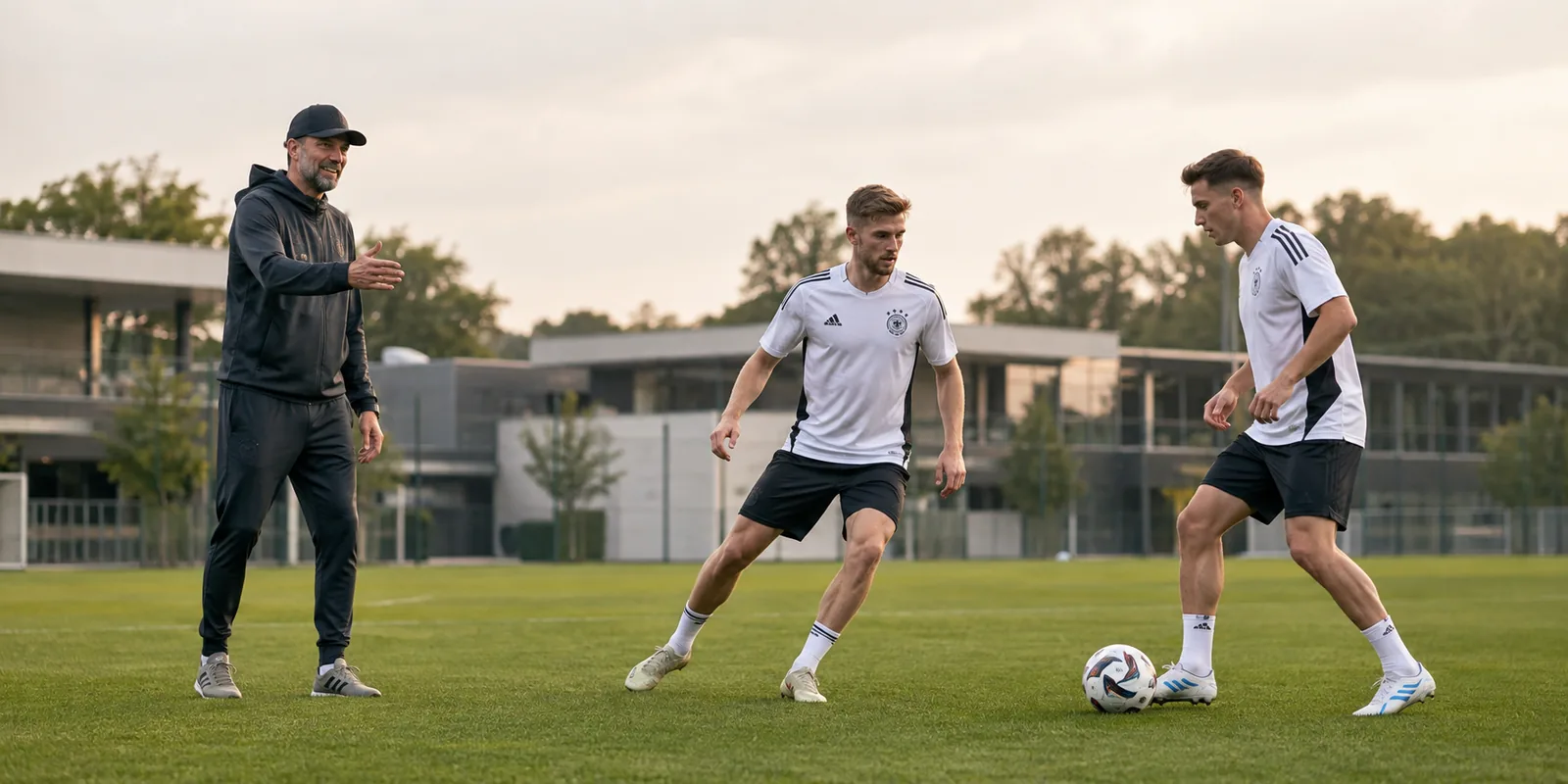
A famous appointment changes expectations immediately. A national team's habits take longer. Short camps leave less time to teach a pressing trigger, adjust the distance between two midfielders or practise what happens when an opponent refuses to play the expected pass.
The useful autumn evidence will be specific. Can a substitute perform the same supporting task as the player he replaces? Does Germany recognise when to press and when to recover its shape? Can the team create another good attack after the first one breaks down? Those are stronger tests than the mood around the first team photograph.
Klopp's September visit to Mainz training adds a practical detail to the new cycle: contact with the clubs that coach these players every week. Cooperation is a starting point, not proof that a system is already established. International football still has to compress the preparation into a few shared sessions.
First objective: earn another knockout stage
A top-two finish in Nations League Group A2 would send Germany into the March 2027 quarter-finals. Germany have five points after four matches; the two remaining November fixtures decide the next step, not a prediction about a trophy. EURO qualifying has its own draw and schedule.
Nations League format: DFB group announcement. EURO qualifying dates: UEFA's draw announcement. Germany are not presented here as already qualified.
The Germany country page keeps the honours and historical timeline. Germany's trophy-drought story explains the longer wait. Germany Now follows what could change it next.
Germany now: frequently asked questions
Quick answersWhen is Germany's next match?
Serbia v Germany is scheduled for 13 November 2026 at 20:45 CET in UEFA Nations League · A2.
Who is Germany's new manager?
Jürgen Klopp succeeded Julian Nagelsmann. The DFB announced his appointment on July 24, 2026, on a four-year contract, with an official start date of August 15.
How far did Germany get at the 2026 World Cup?
Germany won Group E but were eliminated by Paraguay in the round of 32. The match finished 1–1 after extra time; Paraguay won the shootout 4–3.
Why does the results table show a draw against Paraguay?
Match statistics use the score after extra time, excluding shootout kicks. The 1–1 therefore counts as a draw; the separate 3–4 shootout result records Germany's elimination. It was not a 4–5 match score.
Who are Germany's Nations League opponents?
Germany are in League A Group A2 with the Netherlands, Serbia and Greece. Each opponent is played home and away. The top two advance to the quarter-finals.
Is this Germany's confirmed September squad?
The DFB confirmed Klopp's split 44-player plan on September 17: 24 players for the Netherlands and Greece, followed by a refreshed group for Serbia and the return match in Greece. The player watchlist and tactical model remain editorial analysis, not a predicted starting XI.
Where are Germany's home Nations League matches?
Germany’s next scheduled home match is against the Netherlands on 16 November 2026 at 20:45 CET in Berlin. The home matches against Greece on 27 September and Serbia on 1 October have already been played.
Have Germany qualified for EURO 2028?
This update does not list Germany as qualified. The qualifying draw is scheduled for December 6, 2026, in Belfast, with group matches from March to November 2027.
Sources and update policy
Results, coaching announcements and fixtures are checked against DFB, FIFA and UEFA. The Mainz club report supports the training visit only; match dates and venues follow the DFB schedule. Links next to factual sections identify the supporting reports. The player-role discussion and tactical model are editorial interpretation.
This is a manually updated editorial page, not a live news feed. New selections, injuries, venues and results need verification before publication. The chart calculates from the results table; the countdown points to a scheduled kick-off and does not report a live match. Illustrations are conceptual scenes, not documentary photographs.
- DFB · Jürgen Klopp appointment and start date · July 24, 2026
- DFB · Julian Nagelsmann departure
- Mainz 05 · Klopp's training visit · September 1, 2026
- DFB data centre · World Cup Group E results
- DFB · Germany's elimination against Paraguay
- FIFA · Paraguay match and separate shootout score
- FIFA · Ecuador–Germany match report
- FIFA · Florian Wirtz interview · May 23, 2026
- DFB · official fixtures, venues and kick-off times
- DFB · Klopp's first two-part Nations League squad · September 17
- DFB · Nations League group and progression
- UEFA · EURO 2028 qualifying draw and calendar
Latest result and next calendar: verified report · confirmed next schedule.