
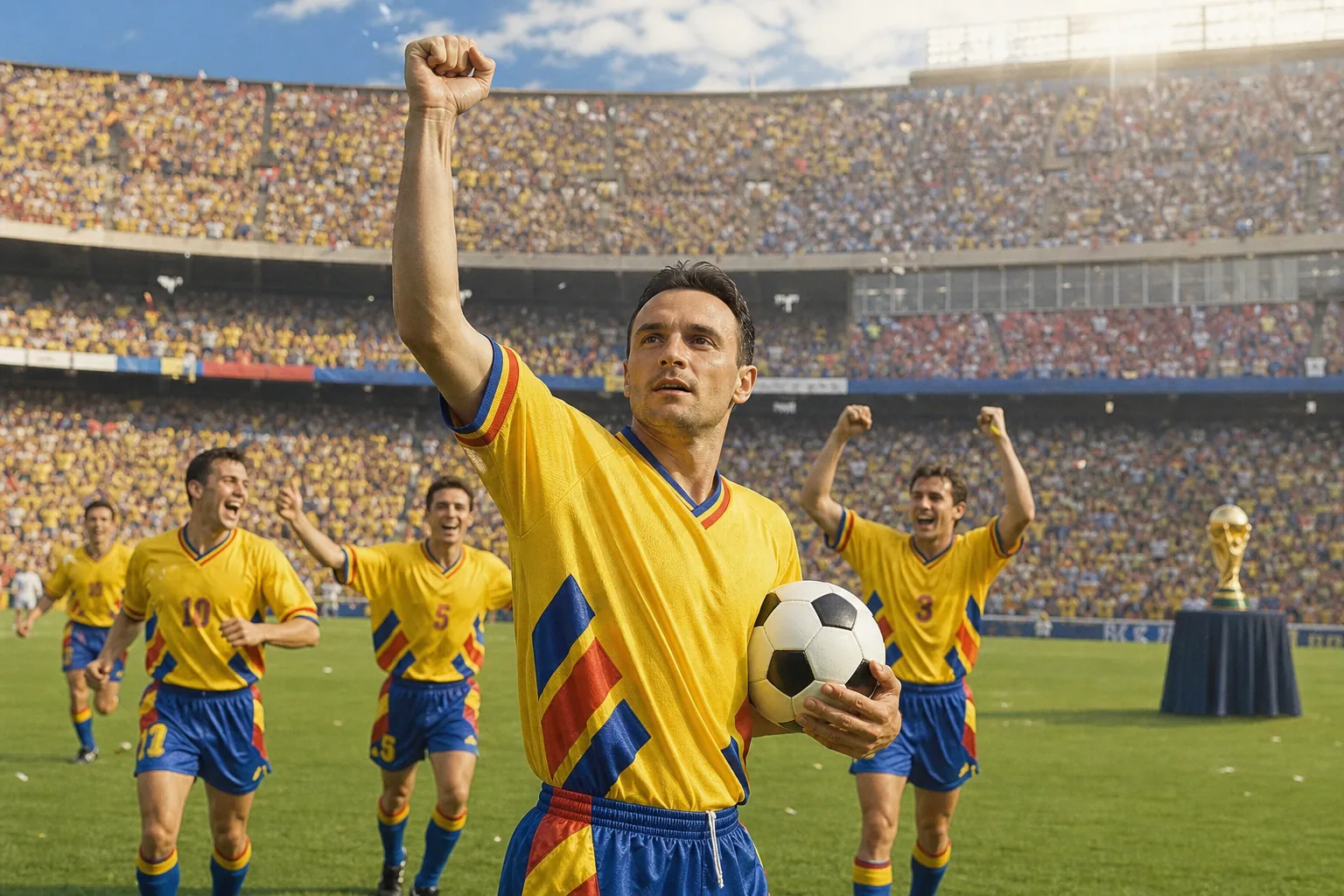
Romania's men's national team own one of the most celebrated World Cup stories never to reach a semi-final. The 1994 side beat Colombia, the United States and Argentina before losing a quarter-final shoot-out to Sweden. EURO 2000 brought another last-eight appearance, while EURO 2024 showed that Romania could still win a difficult group. The missing achievement is unchanged: Romania have never reached a World Cup or European Championship final and have no major title tracked by this site.
World Cup 2026 status
Romania entered UEFA qualifying for the 2026 FIFA World Cup but did not reach the finals. Their most recent World Cup appearance remains France 1998.
| 2026 status | Qualification route | Outcome |
|---|---|---|
| Entered qualifying; did not qualify | UEFA qualifying | Did not reach the finals |

Romania competed at the inaugural World Cup

The Golden Generation reached the World Cup last eight

Romania reached their first EURO quarter-final

Romania won their EURO group before facing the Netherlands

Still waiting for a first major semi-final and title
Romania's World Cup history began at the first tournament
Romania were one of the 13 teams at the inaugural FIFA World Cup in Uruguay in 1930. They also appeared in 1934 and 1938, returned in 1970 and then qualified for three consecutive tournaments from 1990 to 1998. That gives the national team a substantial World Cup history even though no Romanian side has reached the semi-finals.
The modern high point emerged in the middle tournament of that three-edition sequence. By 1994, a technically gifted generation had experience across leading European leagues and a number 10 capable of changing a match from almost anywhere on the pitch.

Why the 1994 World Cup remains Romania's benchmark
Romania opened USA 1994 by beating Colombia 3–1, lost 4–1 to Switzerland and then defeated the hosts 1–0 to finish top of Group A. The round-of-16 match against Argentina became the defining performance. Ilie Dumitrescu scored twice and Gheorghe Hagi added the third in a 3–2 victory over the 1990 finalists.
The quarter-final against Sweden finished 2–2 after extra time. Romania led late in the additional period, Sweden equalised and the shoot-out ended 5–4 to the Scandinavians. The defeat placed a hard boundary around the Golden Generation's greatest tournament, but the route itself remains remarkable: Romania scored ten goals in five games and eliminated one of the competition's traditional powers.
Romania's major-tournament ceiling

Hagi was the symbol of a complete generation
Hagi is the enduring image of 1994, but Romania were not a one-player team. Dumitrescu supplied decisive goals against Argentina, Florin Răducioiu led the line, Gheorghe Popescu organised midfield and Dan Petrescu contributed from the right. Their movement and willingness to attack made Romania one of the tournament's most memorable teams.
The longer-term difficulty was succession. Romania returned to the round of 16 in 1998, but later generations struggled to reproduce the same concentration of elite experience. The comparison with 1994 can inspire, yet it can also distort expectations: a new team does not need to imitate Hagi's side stylistically, but it does need comparable clarity about how its strongest players fit together.
EURO 2000 delivered Romania's continental quarter-final
Romania's best European Championship finish came six years later. Drawn with Germany, Portugal and England, they drew 1–1 with Germany, lost narrowly to Portugal and then beat England 3–2 in the decisive group match. A late Ionel Ganea penalty sent Romania into the last eight.
Italy won the quarter-final 2–0 through goals from Francesco Totti and Filippo Inzaghi. Romania finished with ten players after Hagi was sent off, making it a painful end to his final major tournament. Even so, progressing from that group and reaching the quarter-finals established a continental benchmark that still stands.
EURO 2024 restored a place in the knockout rounds
Romania returned to the European Championship in 2024 and began with a 3–0 win over Ukraine. After losing to Belgium and drawing with Slovakia, they finished first in Group E. All four teams collected four points, so the order was decided by the competition's tie-breaking criteria.
The Netherlands won the round-of-16 match 3–0, but Romania's first group win at a EURO since 2000 and first-place finish gave the modern side an achievement of its own. It did not equal the Golden Generation's quarter-finals, yet it offered a more useful foundation than nostalgia alone.
Romania's men's tournament record at a glance
| Competition | Best result | Landmark edition |
|---|---|---|
| FIFA World Cup | Quarter-final | 1994 |
| UEFA European Championship | Quarter-final | 2000 |
| Most recent World Cup | Round of 16 | 1998 |
| Most recent EURO | Round of 16 | 2024 |
| Major titles tracked | None | Still waiting |

Romania's next target is not another comparison with 1994
The next meaningful milestone is a new quarter-final, followed by the first semi-final in Romanian men's history. Reaching it requires more than one famous upset. Tournament progress usually depends on controlling the matches in which Romania are expected to take initiative, then carrying enough depth to survive three group games and at least two knockout rounds.
EURO 2024 showed that organisation and collective belief can put Romania above stronger squads over a short group. The challenge is to repeat that level against different opponents and turn a successful group into a deep run. Until then, the Sweden shoot-out in 1994 remains the closest Romania have come to the final four.
Romania's route from the 1994 Golden Generation to a first major final
Frequently asked questions
Has Romania ever won the FIFA World Cup?
No. Romania's best World Cup result is the 1994 quarter-final, where Sweden won a penalty shoot-out after a 2–2 draw.
What is Romania's best European Championship result?
Romania reached the EURO 2000 quarter-finals after advancing from a group containing Germany, Portugal and England.
Who scored for Romania against Argentina in 1994?
Ilie Dumitrescu scored twice and Gheorghe Hagi scored once in Romania's 3–2 round-of-16 victory.
When did Romania last play at the World Cup?
Romania's most recent World Cup appearance was France 1998. They reached the round of 16 before losing to Croatia.
How did Romania perform at EURO 2024?
Romania finished first in Group E with four points and then lost 3–0 to the Netherlands in the round of 16.
Data sources & verification for Romania
Trophy dates are checked against official competition information and the relevant football confederation.
See Romania's full Waiting Room profile, tournament record and live counter.
View Romania's Waiting Room profile →